stage magic

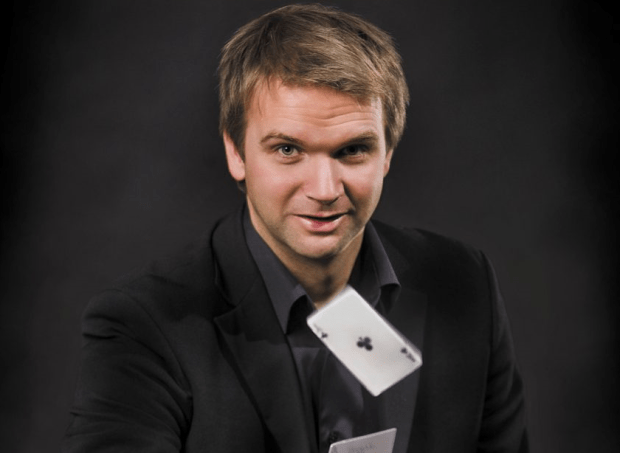
ALEX KOUVATAS: MOVIE MAGIC

☆☆☆

Burritos, milkshakes, and magic are an unfortunately unusual combination. Each one of them is great on its own, but together? Unbeatable! The only place to experience this incredible trinity at the Fringe this year is at Alex Kouvatas’s show Movie Magic, in the basement of Burrito’n’Shake, handily located on a key tourist thoroughfare.

However, aside from providing a frankly iconic combination of refreshments, Kouvatas’s venue did not do him any favors. Staff crossed the stage with some regularity and the music from the restaurant was audible in the performance space. Such are often the trials of the newer PBH venues. The space has a great potential, and hopefully with a bit more experience of the benefits of hosting they will treat their performers with more respect.

Kouvatas was nevertheless unstoppable. Some of the more notable aspects of his performance actually did not include magic tricks. In the show reviewed he performed at times in two languages, neither of them his native language, to ensure that Italian-speaking members of the audience were included as well as the English-speaking majority. He went out of his way to get them involved in ways that were accessible to them. Kouvatas included all of the audience in his show. A participant in the show reviewed was especially enamored of his prop banana, reported to be “pleasingly soft and fun to play with”. While her delight with and repeated caressing of his banana did briefly distract Kouvatas, and indeed the entire audience, this only increased the audience’s engagement.

The magic was well performed and themed to the movies. Kouvatas brought along a special movie card deck, so audience members could choose the movies he themes his tricks on. A moment that feels especially on brand for a magician is when he uses a card trick to try to get one of his participants to fall in love with him. While the participant at the reviewed show did not leave her partner for him, it was a fun romcom take on the effect. That being said, if Kouvatas’s magic could use any advice, it might be on the timing. There was the occasional moment, for example with is escapology trick, where it felt like the timing wasn’t quite right—but this did not detract too much from the overall enjoyment of the audience.

His inclusivity of the whole audience sadly did not always have a positive effect. One participant got a little too enthusiastic and grabbed Kouvatas’s bottom to try to catch him out on a trick. He laughed it off, and even got the rest of the audience to laugh through the uncomfortable moment, an impressive testament to his professionalism despite overt and unacceptable (even if unmalicious) harassment.

While touching his bottom is not advised, Kouvatas’s delightful banana is freely given to a chosen participant, just one of the many reasons why Movie Magic is worth a visit. Kouvatas is an inventive and engaging performer who will get the whole audience involved in the show.

More information on Alex Kouvatas can be found here.

1 HOUR OF INSANE MAGIC

☆☆☆☆

 Barely a week in to their stay at Teviot, Elliot Bibby, Cameron Gibson, and Luke Osey are having a fantastic Fringe. They managed to sell over 50% of the tickets for their show 1 Hour of Insane Magic before the Fringe even started, and most recently confirmed that they’re now at over 75% sold out. They could have sat back and phoned it in for the rest of the month and called it a huge success. Luckily for their audiences they’ve chosen not to do that, they put together a great show and really seem to care about making it a great experience for every audience.

The youngest of the bunch, and apparently the physically invulnerable one, Osey has a formidable amount of magic experience for his age, primarily in creating and selling magic tricks. He’s still inventing, but as of last year is a performer as well. People who have come to the show for his promo photo in particular may be wanting and expecting him to willfully put his body in harm’s way, and he does not disappoint. Osey shoulders the weirdest and most painful looking tasks in the show with apparent ease.

The human embodiment of Kenergy-punk, Gibson is the resident Insane mentalist. Off-stage he is now also known for his magic shop and event space Wonder & Co. As someone who has gone above and beyond the usual call of magic in fulfilling his professional dreams recently, he’s perfectly suited to inspire the next generation, and in a memorable middle segment that’s exactly what he does. Audience members sitting next to the lucky child in question at the reviewed show were adorably distracted by her wonder and delight well into the following segment—the only good kind of audience distraction in performance art.

Bibby is famous within Edinburgh magic scene, he’s organized year-round magic showcases that have been gathering points for the city’s best magicians since before the pandemic, and in past Fringes he’s always seemed keen to hop in to magical supergroups. Throughout the show he’s frequently seen helping out his co-performers during their segments. He has the most classic magician role in the group, but is no less insane for it. A funny card trick sees him taking a creative approach to ensuring that his participants don’t interrupt him, offering them the kindness of a shared meat stick that prevents them from talking before his big reveal.

The Insane Magicians perform plenty of fantastic tricks in their time on stage, but the real magic is in taking their three strong solo acts and making them all work together—which is exactly what they did. The solo performances are interspersed with magic that brings all three of the magicians to the stage at once, which are easily the best parts of the show. Group magic acts have a general reputation for limiting what any one member can truly accomplish, but the simple solution that’s made this one so insanely good is the apparently genuine affection that the three magicians have for each other. It’s translated into the kind of stage chemistry that isn’t usually found outside of well-established double acts, an impressive feat for a trio that only started performing together earlier this year.

There are plenty of great reasons to see 1 Hour of Insane Magic. The pacing is perfect, the tricks all go right, they’re family friendly but universally enjoyable, audiences get to see three whole magicians for one ticket price, and the patter is all very funny. However, what sets them apart is how well their shared bond translates into stage chemistry. The Insane Magicians highlight that they have all had high profile international professional experiences, so while Edinburgh Fringe tickets may be going fast, but if an international tour isn’t in the works, it should be. Edinburghers had better act quick to catch them on home turf.

More information on 1 Hour of Insane Magic can be found here.

YOUNG AND MOXIE

☆☆☆

Putting on a show as a new magic duo and invoking the names of Penn and Teller in all your marketing is a bold move, even by magician standards. It’s impossible to imagine anyone living up to a straight comparison to the stage chemistry of one of the most famous magic partnerships alive. Nevertheless, seasoned magician Cameron Young and Moxie Jillette, daughter of the Penn half of the esteemed pair, make this attempt together as Young and Moxie.

Young and Moxie take an appropriately sneaky approach to getting around this potential issue. They take full advantage of Moxie’s famous parent in their marketing—which can’t be faulted, the Fringe is a notoriously brutal market and it’s entirely reasonable to take advantage of every angle one has to get an audience—but then are quick to frame it as more of a magical apprenticeship for the younger Moxie than a traditional partnership. And if it does feel a bit like a partnership of convenience, they do have a better stage chemistry than might be expected of a pair that did their rehearsing over Zoom.

Most of the stage time is given to Young, the teacher in this scenario, although in contrast to his regular Fringe solo shows his work is peppered with Moxie’s snarky commentary. Young’s tricks are performed with his usual precision. He warms up the crowd with his favorite, predictive magic, and gets everyone thinking through his selection process so the whole audience feels involved.

Maybe it’s just that Fringe audiences are more accustomed to Young’s approach, but Moxie’s take on both magic and performing feel especially exciting. Her version of a classic effect, performed in front of the audience but really just for one person, breathes new life into a tired prop. Her running commentary on Young and his magic is hilarious and apt; her insightful perspective on magic makes the entire production that little bit more interesting. If magic shows had live commentators like sporting matches Moxie would be a perfect fit for the role. While she’s great when speaking to others, whether exchanging banter with Young or vibing with her audience participants, like many younger magicians Moxie comes across as slightly nervous in her monologues. The prevalence of this shortcoming amongst younger magicians would indicate that it is best remedied by the experience that she is currently building.

Young and Moxie is a worthwhile hour of a show, for both performers and even for the spark of their stage chemistry. However, both Young and Moxie simply radiate too much Main Character Energy, in the best possible way for two magicians, for their paired show to feel like a sufficient experience of either of them. While Young’s many fans can also catch him solo at the Voodoo Rooms this year, Moxie’s only available as part of the duo for now. After a glimpse at her unique approach Fringe audiences will surely be equally excited to catch her solo if and when she feels ready.

More information on Young and Moxie can be found here.

JAMIE LEONARD: FOCUS POCUS

☆☆☆

Jamie Leonard is a tough Fringe act to catch. Over the past couple of years he has put on mini runs (by Fringe standards) of just a day or two. Undoubtedly by the time this review is online he will have once again vanished for the year like the proverbial elephant. While the magic might not have been flawless, Leonard is a charming performer and well worth an hour of the audience’s time.

Focus Pocus included a good mix of magic styles, there was something for everyone over the course of an hour. As the audience members entered the venue Leonard asked them to write a random word on a blank card, and the purpose of this was left a mystery for the majority of the show to great effect, with the timing of the reveal calling back to one of his early tricks and ensuring a positive last impression. Not all of the tricks went so well to plan, but Leonard only ran in to a couple of issues and was quick to salvage what he could. Focus Pocus is decidedly comedy magic, and that attitude of not taking himself too seriously served Leonard well when things didn’t go as perfectly as he might have hoped.

In a small venue early in the afternoon, Leonard found few volunteer participants, but enough to not have to resort to picking people at random. He establishes a strong rapport early on, and is mindful of the variety of age ranges in his audience. When his participants pick a naughty number for him to use for one of his tricks, he comments on it directly enough to get a laugh from the adults but obliquely enough that he hopefully didn’t prompt any awkward questions from the younger children.

Appropriately for a comedy magician, Leonard is a funny guy, with great comic timing, especially when joking with his audience. If the magic isn’t perfect yet it seems reasonable to attribute that to his youth, he doesn’t mention his age but joking about homework certainly makes him sound on the younger side. But it’s his calm attitude towards mistakes and distractions that comes across as the best sign for the future of his performance career; the ability to not let setbacks derail a performance is perhaps the most important quality in any performer. Fringe audiences may have to wait until next year to catch a glimpse of Leonard’s magic, but they won’t be disappointed by his performance—regardless of whether or not the tricks go right.

More information about Jamie Leonard can be found here.

SUHANI SHAH: SPELLBOUND

☆☆☆☆☆

A newcomer to the Edinburgh Fringe, Suhani Shah presents a semi-autobiographical show with Spellbound. While she does deservedly brag a bit—about winning over her parents’ approval to devote her life to magic at a young age, and managing to find daily audiences as a talented youngster—she’s relatively humble about her current renown in her home country. To imagine her place in India’s cultural consciousness, UK audiences might find it helpful to picture Derren Brown as a woman with about ten times the Instagram following.

Shah’s easy rapport with the audience emerges from the start. She has a personable stage presence, and audience volunteers respond to her like she’s an old friend. At the reviewed performance some may have been a little too friendly. One of her first participants in particular was eager to shoot his shot with her, apparently in front of his wife, and Shah integrated their banter as a running joke for the rest of the show. Shah asks for volunteers before picking on random individuals, and she has no lack; in the reviewed show she did not need to resort to pulling up the unwilling.

The actual mentalism that she performs is nothing short of flawless. The basis of many of her effects will be familiar to magic fans, but she adds her own twist. Shah tells the audience about her childhood pitching up in a venue for months at a time to perform, and rightly points out that the Edinburgh Fringe is her natural habitat. One of her well personalized effects is her retelling of how she convinced her parents to allow her to lead this life, a blindfolded trick using her father’s handkerchief and a piece of her mother’s chapati dough—or here, a bit of dough she brought along and an audience member’s handkerchief. She responds blind to prompts in varied ways, allowing for new reveals to the same trick.

While acknowledging that everything that she does is a learned trick, Shah does not shy away from doing her level best to convince her audience that she’s genuinely magical. In a clever bit of show planning, the most fun element of this comes after she winds up a more traditional mentalism routine, when the audience is expecting another set-up but instead gets the immediate gratification of more magic. She doesn’t reveal anything that could potentially cause embarrassment, and in fact tells a funny story about when she learned to avoid that, but the details she discusses are specific and personal enough to make it a highly memorable moment in the show.

By Shah’s account there are at least a couple of similarities between the Indian and the Edinburgh Fringe magic scenes. In both cases there are very few female magicians and even fewer mentalists. As far as this publication is aware, Shah herself is the only female mentalist at the Fringe this year—although we welcome correction if any other female mentalists at this year’s fringe would like to get in touch. Spellbound may be Shah’s way of introducing herself to Edinburgh but it feels like the launch of a new Fringe superstar. In that endeavor Shah can only be a success, everyone in her Spellbound audience will be eager to see more from her.

More information on Suhani Shah can be found here.

HECTOR MANCHA: THIS IS NOT MAGIC

☆☆☆

Hector Mancha transforms the Scottish Storytelling Centre’s stage over the course of This Is Not Magic. The space starts completely empty, giving no hint as to what is to come, but by the end is covered by a carpet of discarded cards and crisps in almost equal measure. This chaotic staging perfectly matches the organized chaos of the show. The premise is that Mancha will teach the audience magic, and he uses this to show just enough to increase the surprise of his reveals.

That being said, perhaps the most impressive aspect of the performance is how well Mancha incorporates various audience interruptions in to his act. Future audiences should be advised that if they sit in Mancha’s first row and take off their shoes they may receive a brief foot massage included in the price of their ticket—although they may also find their discarded shoes temporarily abducted. Less lucky audience members with a blocked noses do not need to worry about loudly blowing their nose during the performance, Mancha will incorporate the sound effect in to the show. These improvised moments bring Mancha’s show to life, making his audience feel fully incorporated in his act.

Those invited to join Mancha onstage are treated with equal friendliness. In the reviewed show Mancha bonds especially well with an Argentinian tourist who ends up helping out for a couple different tricks. In one sequence with her Mancha proves himself immune to the mild germaphobia that affects most of us post covid, eating discarded crisps off the floor of the stage that they have both been stepping on. An even riskier gambit involves relying on an audience member managing to video call a friend to participate—but Mancha gets his videochat in the end, for an especially exciting conclusion to his longest running effect.

Magically, Mancha mostly always fools his audience when he wants to. If a can of soda is occasionally spotted slightly earlier than it is revealed it hardly affects the overall effect of his performance. His most riveting piece is not magic in the usual sense but a shadow puppetry effect set to music, a highly unusual but hugely enjoyable inclusion in the show.

The aspects of the performance that make Mancha stand out—his inclusion of the full audience and his shadow puppetry—may not be traditionally magic effects (although audience management is an important element of all magic shows). These cement Mancha’s status as a unique performer well worth an hour of his audience’s time.

LEWIS BARLOW: THE WAY OF THE MAGICIAN

☆☆☆☆

As much as everyone loves a plot-driven magic show, sometimes a magic fan is in the mood for the classic: a series of tricks loosely tied together by stories that the magician happens to find interesting. The Way of the Magician is the perfect show for those occasions. Lewis Barlow is faultless in his performance of a variety of card and coin tricks, often themed on characters from his life or magical history.

Barlow excels at his card finding and trick dealing in particular. The audience expects him to find the cards they choose, nothing is more basic in the performance of magic, yet Barlow finds a way to display that concept in new, increasingly interesting ways—proving that he can surprise and amaze, even regardless of whether or not collects the chosen card back from his participant. More “practical” displays of trick dealing prove fascinating as well, linking in with Barlow’s brief but fascinating educational segment on a historical card cheat.

New technology abounds at Magicfest. Barlow makes great use of a live camera stream to make sure that his magic is visible to the whole audience. This results in several wholesome moments in the show. Early troubles with the camera bring local celebrity and Magicfest big boss Kevin Quantum to the rescue, in a display of Quantum’s hands-on care and support for the artists in his festival. Later on Barlow takes a second to admire how good his card tricks look on the big screen—a well-deserved moment of self love. The audience concurs with his assessment.

Audience members are treated well by Barlow. They are often used to simply choose a card from their seats, perhaps a wise time saving move to reduce show time spent waiting for large numbers of participants to shuffle back and forth down the rows of seats. With so many card finding tricks, this is a significant factor. When choosing individuals to actually join him on stage Barlow kindly opens the floor to volunteers in the first instance, allowing for a very enthusiastic young audience member to experience the magic up close.

If The Way of the Magician indicates anything about what it’s like to be a magician, it’s implicitly, in the freedom that Barlow takes in creating a show out of random things that he likes and finds interesting. Maybe sometimes that’s all that is needed. 

More information on Lewis Barlow can be found here.

NEIL KELSO: SOUNDS IMPOSSIBLE – A MUSICAL MAGIC SHOW

☆☆☆☆

Magicians are inherently nerds, regardless of whether or not they lean in to it in their shows. In the more interesting shows they might reveal their nerdiness about something other than magic, and Neil Kelso does in Sounds Impossible: A Musical Magic Show. His discussion of musical theory will probably be new to just about everyone in the audience, even those of us who learned piano casually as children. While the magic is itself impressive, it is a secondary aspect of the performance, enhancing the discussion and performance of music. This is to Kelso’s benefit, setting him apart and making for an especially interesting show.

The magic starts classically and visibly, with a trick that happens both in Kelso’s hands and in the hands of his audience members. However, a highlight of the show is the perfect combination of the musical and magical aspects in a card finding effect that uses the piano to find the cards. An audience member in the front row of the reviewed show had a satisfying reaction as the magic revealed itself, gasping loudly and clutching her partner’s arm. Seeing that Kelso can provoke this reaction in his audience is a reminder to frequent magic show attendees of how it feels to see these incredible feats for the first time.

Kelso evidentially knows at least as much about the history of pianos and music as he does about magic, and it’s great to get to hear some of this knowledge from him. He covers everything from historical differences in tuning standards—listing a few famous composers and describing how the instruments of their day would be tuned higher or lower than the one he plays on—to the effects of air pollution and recent research in to how to potentially counteract it, for example how living under a flight path might affect people. The magic draws people in, but once they are there they may wish that more of the performance were dedicated to this musical education.

Sounds Impossible: A Musical Magic Show does indeed sound impossible at first, but Kelso pulls off the premise and more. With a broad appeal, he gets people from both sides—impressing the magic fans with his breadth of music knowledge and the music fans with the magic tricks. He has a pretty universal appeal. Fans of either aspect of his performance will be sure to see something new.

ALEX KOUVATAS: SOMETHING IS MISSING

☆☆☆

The 2021 Fringe didn’t feel like a real Fringe, and there is a noticeable trend of some performers re-doing their prior shows for those who missed them last year. Alex Kouvatas joins them with his 2021 debut, Something is Missing. If he is a bit less popular this year it is probably because he was so popular last year, Edinburghers and regular Fringe-goers will have already seen him, plus apparent venue troubles may have resulted in difficulty in finding him. However, for those who manage to seek him out it is worth the effort.

With a small audience at the reviewed show, Kouvatas was able to get everyone involved. The first participant in particular was especially excited to join him, waving to her friends and posing for their cameras. The effect that she was involved in is a highlight, showcasing Kouvatas’s excellent ability to weave his tricks in to stories—in this case a magical, non-threatening take on William Tell shooting an apple off of someone’s head. While there is less of a theme running through the show this year, which is missed, that storytelling remains a strong point.

With his venue change, and falling victim to the small audience plague that is running rampant throughout this year’s Fringe, one would think that Kouvatas had more than enough misfortune to deal with. However, unfortunately at the reviewed show he also had trouble with his table, which dramatically broke part of the way through the show. He managed to play this off admirably well—the audience seemed to half expect him to wave a plastic wand and the table would restore itself. However, it was just a misfortune. Aside from the incident itself the show did not appear to suffer for the lack of the table.

Despite the misfortune surrounding this year’s iteration of Something is Missing, Kouvatas’s passion and showmanship shine through. He has clearly been hard at work, he no longer has to refer to a script and has a more consistently strong transition between tricks. While the theme and ideas behind the prior iteration are missed, these may be a casualty of the troubles Kouvatas faced this year. The overall improvement in his performance is noticeable. The show reviewed was towards the end of this year’s Fringe, but hopefully he has better luck next year.  Kouvatas deserves to reach a wider audience.

JAMES PHELAN: THE GREATEST MAGICIAN

☆☆☆

Magicians like to give the impression that they control every last second of their shows, but the one thing that they can never fully control is their audience. On the day that The Greatest Magician was reviewed James Phelan spent a lot of his time playing whack-a-mole with unruly audience participants. His crowd control was a bit hit or miss, if he was a little sharp with the odd individual the audience as a whole generally felt that they deserved it, this did seem to affect the kind of people who volunteered to join him, which may have exacerbated the issue. Nevertheless, through all of this Phelan managed to keep the audience on his side and get through a series of impressive tricks.

The audience management was probably the more impressive feat. Phelan had audience participants misunderstanding his instructions, he invited up wannabe comedians… it was the full range of troublesome participants. While getting understandably a bit annoyed at first, by the end of the show he was handling this with grace. He allowed the self-appointed comedian to tell his joke, “I went in to a spaghetti restaurant and tried to steal some spaghetti, but there was a security guard and I couldn’t get pasta”, before inviting him to leave the stage. And he ran through as many participants as necessary for his initial card trick, patiently waiting to find enough participants sober enough to help him out—surprisingly a difficult task on a Friday afternoon (you can add in a joke about Scottish drinking culture if you’d like).

Magically, Phelan describes the inspiring influence of his uncle, Paul Daniels. His adorable childhood photos are a highlight regardless of whether or not the viewers previously knew of Daniels. Hearing about a magician’s childhood inspiration to perform magic is not unusual, but the way Phelan connects it to his tricks is especially satisfying. Phelan’s trick involving making his participants forget how to read is fun to watch.  However, after he follows it up with a story about performing this effect on a teacher who told him he would never make it as a magician the audience surely appreciates it even more. 

Whether or not Phelan is truly The Greatest Magician is up for the audience to decide, but he is definitely a resilient performer.  Managing to keep his show on track in spite of numerous attempts to derail it, however lightheartedly, can not be easy.  Phelan will impress his audience no matter how much they might try to resist.