mentalism

CHRIS COOK: THE ART OF TAKING PART

☆☆☆☆☆

Last year, Chris Cook celebrated ten years of performing at the Fringe. This year, promotion for his new show The Art of Taking Part sounds almost like an abdication of his role as a magician, giving the show over to the audience to provide entertainment for each other. In practice this is not the case. The audience does not need to fear that they are being put on the spot to create the show for their peers, Cook’s guiding hand ensures that the show stays magically on course.

On the rainy weekday evening that this show was reviewed, the fact that Cook managed to get any audience at all was very impressive. Those that were there were the ones who really wanted to experience the show, which was actually perfect for the type of performance that it is. Every participant that Cook brought to the stage was enthusiastic in taking on their roles. There is an element of random selection as well, and for two of the elements requiring a very minor bit of physical skill Cook had the misfortune of selecting one of the most physically incapable people in the room, possibly in the world—this reviewer. Even then, Cook managed to keep the show on track with kindness and professionalism.

To celebrate The Art of Taking Part, Cook regularly rewards his participants for joining him on stage. This is not achieved just through physical gifts, although those do appear on occasion, but Cook also places emphasis on tricks that happen in his participants’ hands, or that center the participant as the one taking credit for the magic part of the segment. One trick in particular sees a volunteer member of the audience take over the role of the central performer, and at the reviewed show she really got in to it, fully appreciating her share of the spotlight. Nevertheless it is clear that Cook is pulling the magical strings, there are plenty of skilled reveals over the course of the show.

Over the course of the show, The Art of Taking Part is revealed to be as much a manifesto on the nature of magic as an art form as it is the title of the show—the necessity of interaction with the audience is one of the key aspects of magic that sets it apart from most other performance arts. Cook devotes his show in part to celebrating this feature of magic, which gives the performer a unique ability to connect directly with members of the audience on a personal level. Arguably this facet is the crucial factor that has enabled Cook to create ten years of Fringe shows that are slowly but surely making the world a better place. At the same time, it’s a deeply silly show that gives the audience a chance to embrace the fun of magic, often in their own hands.

Cook’s habitual emphasis on guiding his audience toward self improvement is still very much present this year; regular fans will not be disappointed. For the perfect blend of seriousness and silliness The Art of Taking Part is the place to be.

More information on The Art of Taking Part and its performance dates can be found here.

TOMAS MCCABE: 1 MURDER: THE MIND READING LAWYER

☆☆☆☆

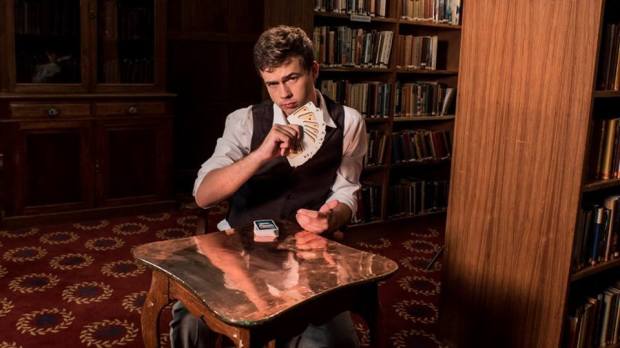
Of all the jobs that would be easier for someone who can read minds, barrister must be right up there. Real life future barrister Tomas McCabe has combined his profession of the near future with his current job as a mentalist in 1 Murder: The Mind Reading Lawyer. Between the numerical name to push himself to the front of the Fringe program, the fun theme, and his adorable parents on hand to enthusiastically flyer for him across the streets of Edinburgh, McCabe appears to be having a very successful Fringe. Historically he’s often had a late night free Fringe spot, garnering a huge audience of largely drunk people, but this year he has maintained that success at a ticketed slot in the late afternoon, selling out his venue even on the weekday of this review.

The murder trial framing is a fun structure on which McCabe hangs his mentalist demonstrations. It is, however, primarily in place for structural purposes. This is a mentalism show and not the place to find an accurate reconstruction of a murder trial—hopefully to no surprise, given the clarity of the marketing material—but McCabe does take the time to ensure his audience knows that his show is not intended as an educational experience. Some in the audience may learn the British word for a trial lawyer, “barrister”, but that is the beginning and end of the informational portion of the show.

McCabe’s mind reading is accurate as ever. One of his recurring favorites is to have his audience write down anonymous confessions that he then reads from the minds of audience volunteers to ensure that the anonymity of the original confessor is maintained. It feels appropriate that, of all the mentalists, it’s a lawyer who has managed to successfully integrate mentalist-participant confidentiality into the fabric of his act without undercutting his ability to show off his mind reading skills.

The audience participants themselves who are chosen are for the most part self-selecting volunteers. If McCabe chooses random participants for some tasks, it’s the ones that are the least time consuming or attention grabbing. One of the cutest moments of the show is when he selects one of his younger fans to preside over the performance as his judge. This youngster gets a special experience and positive attention that will no doubt be a lasting memory.

Toward the end of The Mind Reading Lawyer, McCabe reveals that now that he has completed his education he will shortly be taking his talents to a real life barrister role, in an actual courtroom. McCabe will no doubt prove popular with his clientele for his reassuringly unflappable presence and, of course, mentalist abilities.

More information on 1 Murder: The Mind Reading Lawyer and its performance dates can be found here.

COLIN CLOUD: CONSEQUENCES

☆☆☆☆☆

Colin Cloud is no stranger to the Edinburgh Fringe. His gigantic, sold out venue on a rainy Monday evening is a testament to the work he has put in to building his Scottish fanbase. These days he is usually based in the US, and recently became renowned for putting a small American town called Las Vegas on the map as a holiday destination when he opened his new headline show there. This year is also Cloud’s first full Fringe run since the pre-pandemic era, and to mark those special occasions his show Consequences is a mentalist retelling of how the consequences of various moments in his life have led to the moments that each audience spends in his company.

It’s easy to assume that a magician has full control over everything that happens in their theatre—which is not always the case, as much as they might pretend—but Cloud regularly caters to the skeptics in his audience by inviting outside input in to his shows. As the audience files in to Consequences each evening they find Cloud sitting onstage wearing a blindfold, with instructions on the screen behind him to ask their social media friends and followers for random words to be used to create one of the impossible moments later in the show. Cloud’s use of popular technology to make his magic seem even more impossible is one of his signatures, and always gets a great reaction from the audience.

As with many of his colleagues, Cloud’s road toward his career in magic began when he was a child, and the audience is treated to stories that provoke a range of emotions in the retelling. Each is accompanied by a mentalism effect to illustrate key themes in the story. Cloud is often described by both himself and others as the real life Sherlock Holmes, an apt comparison, and in Consequences his childhood love of mystery books is cited as one of the factors leading to his present reality. His mentalism is here framed as deductive reasoning, and of course, like magicians, the best mystery writers are masters of misdirection. Fellow fans of Conan Doyle will especially enjoy Cloud’s book trick, and trying to guess popular words from the famous stories while Cloud deduces them magically.

Cloud gets a fair few members of the audience involved in his show, sometimes at random but often also by choice. He is kind to his participants and especially apologetic when, on occasion, he asks them to do a slightly more confusing task for the sake of the trick. With a venue large enough for balcony seating, those who wish to secure their safety from the stage are able to put an entire staircase between themselves and Cloud.

It won’t be news to fans of magic and mentalism in Edinburgh that Consequences is an excellent, must see show of this year’s Fringe. Cloud is the go-to for those who want to tick magic off their Fringe checklist without having to fear the risk of a poor quality performer, and he does not disappoint. Each year has added a ever growing depth and nuance to the structure and format of his shows, and Consequences is a welcome addition to that trend, with a blend of storytelling and Cloud’s classic comedy mentalism that feels distinctly unique. While each evening of Consequences offers a moment for the audience to reflect on the results of both Cloud’s and their own pasts, Cloud’s constant self improvement is a testament to the reality that dealing with the consequences of the past never stops, and the power of each individual to take advantage of that to undertake actions in their present to improve their future consequences. 

More information on Consequences and its performance dates can be found here.

SURREAL: THE MIND-READING SHOW FROM BERLIN!

☆☆☆☆

Stepping in to Surreal: The Mind-Reading Show from Berlin! feels like stepping back in time.  We visit the era of mentalism presented as the junction of the scientific and the spiritual, embodied in a mythical, magical woman. Psychic Vivian and her partner in performance Roman Maria von Thurau take turns playing the role of the mentalist and the assistant. Decorative and magical in turn, their mentalism demonstrations are equal parts impressive and beautiful.

An early sequence sets the scene for the style of the show. Vivian is blindfolded on stage while Roman requests that members of the audience hold out objects for her to describe without seeing. Vivian successfully describes a varied range of such random objects, interspersed with a variety of fun facts that are so perfectly timed and perfectly amusing that the audience almost doesn’t care if they are genuinely true.

Roman, the mathematician of the pair, follows up with a pi-based routine that blends classic calculator based mentalism with what he describes as a pandemic boredom-induced knowledge of the digits of pi. Few performers can make a recitation of a random selection of the digits of pi fun to watch, but Roman manages it, with a final revelation that the audience won’t see coming.

The third star of Surreal is the beautifully realized animations interspersed amongst the magic, which were hand drawn by Vivian in preparation. Vivian accompanies her artwork with autobiographical self-mythologizing stories from hers and Roman’s life. It’s impossible to choose which is the highlight of the show, the artwork or the magic, and the audience is lucky to be treated to both.

At the reviewed show, Surreal was briefly interrupted by several small technical issues. Such are often the pitfalls of a review relatively early in the run. Vivian and Roman dealt with these with steadfast professionalism—future audiences can be confident that they will witness a beautiful show regardless of any such issues. Their vintage throwback style suited it; after all technology is known to behave erratically in the presence of psychic powers such as Vivian’s. The magic goes much more smoothly than the technology.

With its central location, post-workday time slot, and of course beautifully performed mentalism, Surreal will undoubtedly prove to be a hit this Fringe. Vivian and Roman’s vintage presentation of mentalist classics sets them apart from the crowd of magicians at this year’s festival. If Vivian and Roman are not ageless immortals who entertained eighteenth century nobility with their timeless performance style, the lineage from historic performances to theirs is especially clear to see, and renews magic fans’ appreciation for the heritage of magic as an art form. Fans of mentalism in its contemporary iteration in particular will be delighted by this stylish throwback.

More information on Surreal and its’ performance dates can be found here.

COLIN CLOUD: AFTER DARK

☆☆☆☆☆

Scotland’s number one export may be petroleum (which surprisingly surpasses the beverage category) but its number one boomerang export is apparently its mentalists. After Dark sees the return of Colin Cloud’s magnificent hair to the Edinburgh Fringe stage after four years away, and Edinburghers have given him a warm welcome- the reviewed show was to a packed audience that queued all the way around McEwan Hall.

Many might remember Cloud’s incredibly extra approach to showcasing his mentalism abilities, and they will not be disappointed by this show. It’s a common final reveal for a magician to have a prediction to read out at the end of the show that demonstrates that they knew everything was going to happen, and Cloud is no different—except that he wrote and posted his predictions to a member of the audience several months prior to the show, and had that audience member bring the envelope up on stage at the start of the show. It was like a scene out of a Doctor Who finale, which was undoubtedly intentional. Cloud also demonstrates what is either a very impressive ability to know what is on IMDb pages, or a very sad but still kind of impressive encyclopedic knowledge of the whole of IMDb, in a mentalism feat that gets the whole audience involved in the fact checking.

This year Cloud has a new message, a new way to add meaning to his magic, by drawing on his own journey toward mental wellbeing. Cloud illustrates how random chance can feel like a guiding force toward the future during times of distress, using an origami fortune teller much like many would have used as schoolchildren to read audience members’ minds.  This feels like classic Cloud work. To visualize a personal low point, he switches gears into the kind of stunt work that his fans may be less used to seeing him perform. The stunt he performs usually comes across as kind of gross, but here, accompanied by the retelling of his story, it feels oddly wholesome and uplifting—it’s the overcoming of the physical danger that’s emphasized, more than the introduction of it. The story of his past is of overcoming that physical harm by lucky chance, but the danger presented onstage is overcome by choice, with the skill and practice of his profession.  Cloud demonstrates his personal growth even in the retelling of a personal low. 

After Dark may be initially presented as the return of the king, and that’s very much the case. However, he’s a changed king, and here he shares the life lessons he’s learned with all the ability and flair that made him renowned in the first place. Edinburgh welcomes his return to the point that his huge venue may very well be sold out for the rest of his run, but those lucky folks who have bought tickets can be sure they won’t regret it.  Cloud once again sets the standard for excellence in mentalism at the Fringe. 

KEVIN QUANTUM: MOMENTUM

☆☆☆☆

Crowd pleaser Kevin Quantum is back, this Fringe down one healthy leg. Quantum injured his Achilles’ tendon shortly before the Fringe, but in true performer style is nonetheless onstage every afternoon this month, in a big plastic boot and zippered trousers so he can show it off. He has titled and themed his show on Momentum this year, both in terms of science and the course of life itself. It’s fittingly enough considering that he is visibly pushing himself forward at every show, maintaining the momentum of his career and art form in spite of his injury.

Momentum is a family show, and Quantum makes sure to get the younger audience members involved as often as is appropriate—even if that means asking children to volunteer the grown up they’re with to join Quantum onstage. However, Quantum gets as many children as possible involved in the actual magic, even running through the audience on his injured leg to perform pieces of close up magic to various children in their seats. A live stream makes sure that the entire audience is involved, but the chosen children get a special experience.

Unfortunately Quantum had a few angle issues with his live stream at the reviewed performance, both in the crowd sequence and a later bit themed on the Bermuda Triangle. It’s a tricky business performing for both the audience at large and maintaining the participant experience, and while at times Quantum deliberately plays on this to great effect, there are other instances where a prop appears slightly early, or a word card is seen from the wrong angle, that look a little less than perfect. However, it’s a nitpick in an overall entertaining show. The overwhelming majority of Quantum’s magic goes perfectly to plan.

Quantum’s background is in physics, and it’s his fascination with the patterns of a Newton’s Cradle that bookends the show. Magicians often end their performance with a dangerous stunt, and Quantum’s involves a giant flaming Newton’s Cradle. It’s a beautiful piece of equipment even regardless of the stunt, the flaming cannon balls are gorgeously hypnotic. The fact that Quantum manages to pull off the stunt with an injured foot is even more impressive.

Quantum is one of the established big names in all-ages magic at the Fringe, and he proves his reputation every year. Momentum looks like it’s going to be another in his long list of sellout Fringe shows, and deservedly so. Momentum is a solid hour of amazement.

1 HOUR OF INSANE MAGIC

☆☆☆☆

 Barely a week in to their stay at Teviot, Elliot Bibby, Cameron Gibson, and Luke Osey are having a fantastic Fringe. They managed to sell over 50% of the tickets for their show 1 Hour of Insane Magic before the Fringe even started, and most recently confirmed that they’re now at over 75% sold out. They could have sat back and phoned it in for the rest of the month and called it a huge success. Luckily for their audiences they’ve chosen not to do that, they put together a great show and really seem to care about making it a great experience for every audience.

The youngest of the bunch, and apparently the physically invulnerable one, Osey has a formidable amount of magic experience for his age, primarily in creating and selling magic tricks. He’s still inventing, but as of last year is a performer as well. People who have come to the show for his promo photo in particular may be wanting and expecting him to willfully put his body in harm’s way, and he does not disappoint. Osey shoulders the weirdest and most painful looking tasks in the show with apparent ease.

The human embodiment of Kenergy-punk, Gibson is the resident Insane mentalist. Off-stage he is now also known for his magic shop and event space Wonder & Co. As someone who has gone above and beyond the usual call of magic in fulfilling his professional dreams recently, he’s perfectly suited to inspire the next generation, and in a memorable middle segment that’s exactly what he does. Audience members sitting next to the lucky child in question at the reviewed show were adorably distracted by her wonder and delight well into the following segment—the only good kind of audience distraction in performance art.

Bibby is famous within Edinburgh magic scene, he’s organized year-round magic showcases that have been gathering points for the city’s best magicians since before the pandemic, and in past Fringes he’s always seemed keen to hop in to magical supergroups. Throughout the show he’s frequently seen helping out his co-performers during their segments. He has the most classic magician role in the group, but is no less insane for it. A funny card trick sees him taking a creative approach to ensuring that his participants don’t interrupt him, offering them the kindness of a shared meat stick that prevents them from talking before his big reveal.

The Insane Magicians perform plenty of fantastic tricks in their time on stage, but the real magic is in taking their three strong solo acts and making them all work together—which is exactly what they did. The solo performances are interspersed with magic that brings all three of the magicians to the stage at once, which are easily the best parts of the show. Group magic acts have a general reputation for limiting what any one member can truly accomplish, but the simple solution that’s made this one so insanely good is the apparently genuine affection that the three magicians have for each other. It’s translated into the kind of stage chemistry that isn’t usually found outside of well-established double acts, an impressive feat for a trio that only started performing together earlier this year.

There are plenty of great reasons to see 1 Hour of Insane Magic. The pacing is perfect, the tricks all go right, they’re family friendly but universally enjoyable, audiences get to see three whole magicians for one ticket price, and the patter is all very funny. However, what sets them apart is how well their shared bond translates into stage chemistry. The Insane Magicians highlight that they have all had high profile international professional experiences, so while Edinburgh Fringe tickets may be going fast, but if an international tour isn’t in the works, it should be. Edinburghers had better act quick to catch them on home turf.

More information on 1 Hour of Insane Magic can be found here.

SUHANI SHAH: SPELLBOUND

☆☆☆☆☆

A newcomer to the Edinburgh Fringe, Suhani Shah presents a semi-autobiographical show with Spellbound. While she does deservedly brag a bit—about winning over her parents’ approval to devote her life to magic at a young age, and managing to find daily audiences as a talented youngster—she’s relatively humble about her current renown in her home country. To imagine her place in India’s cultural consciousness, UK audiences might find it helpful to picture Derren Brown as a woman with about ten times the Instagram following.

Shah’s easy rapport with the audience emerges from the start. She has a personable stage presence, and audience volunteers respond to her like she’s an old friend. At the reviewed performance some may have been a little too friendly. One of her first participants in particular was eager to shoot his shot with her, apparently in front of his wife, and Shah integrated their banter as a running joke for the rest of the show. Shah asks for volunteers before picking on random individuals, and she has no lack; in the reviewed show she did not need to resort to pulling up the unwilling.

The actual mentalism that she performs is nothing short of flawless. The basis of many of her effects will be familiar to magic fans, but she adds her own twist. Shah tells the audience about her childhood pitching up in a venue for months at a time to perform, and rightly points out that the Edinburgh Fringe is her natural habitat. One of her well personalized effects is her retelling of how she convinced her parents to allow her to lead this life, a blindfolded trick using her father’s handkerchief and a piece of her mother’s chapati dough—or here, a bit of dough she brought along and an audience member’s handkerchief. She responds blind to prompts in varied ways, allowing for new reveals to the same trick.

While acknowledging that everything that she does is a learned trick, Shah does not shy away from doing her level best to convince her audience that she’s genuinely magical. In a clever bit of show planning, the most fun element of this comes after she winds up a more traditional mentalism routine, when the audience is expecting another set-up but instead gets the immediate gratification of more magic. She doesn’t reveal anything that could potentially cause embarrassment, and in fact tells a funny story about when she learned to avoid that, but the details she discusses are specific and personal enough to make it a highly memorable moment in the show.

By Shah’s account there are at least a couple of similarities between the Indian and the Edinburgh Fringe magic scenes. In both cases there are very few female magicians and even fewer mentalists. As far as this publication is aware, Shah herself is the only female mentalist at the Fringe this year—although we welcome correction if any other female mentalists at this year’s fringe would like to get in touch. Spellbound may be Shah’s way of introducing herself to Edinburgh but it feels like the launch of a new Fringe superstar. In that endeavor Shah can only be a success, everyone in her Spellbound audience will be eager to see more from her.

More information on Suhani Shah can be found here.

CAMERON GIBSON: MYSTERIES; AN HOUR OF IMPOSSIBILITIES

☆☆☆☆

If previous years’ trends are anything to go by, Fringe goers love watching a beautiful and stylish Scottish mentalist read people’s minds.  For all in search of this, Cameron Gibson is the mentalist to go to this year.  There is more to recommend him than just physical beauty—he is also a funny and compelling performer.  In his wordily titled Mysteries; An Hour of Impossibilities Gibson displays a well structured mentalist show. 

Gibson does not limit himself to mentalism, opting for a classic cup and ball to get the show going, to great success.  A few tipsy audience members who had wandered in apparently entirely aware of what they were getting themselves in for could be heard commenting that Mysteries; An Hour of Impossibilities was already the best show they had seen this year as Gibson set his cup and ball to the side.  The one slight hiccup came in his transition to the more mentalism-themed part of the show, when a supposedly suggestible participant was slightly less suggestible than expected, but Gibson did not miss a beat, and her initial hesitation only made the second step of Gibson’s work with her that much more impressive. 

However the main event is Gibson’s mind reading using personality questionnaires that he had asked the audience to fill in immediately on entering the venue.  The quasi-psychological twist of using personality tests rather than just random bits of information adds interest.  Gibson outlines the personality types of his participants based on their responses, in what he freely admits are horoscope-level generalizations, before accurately mind reading more specific details.  The range of information gleaned and individuals read made for an exciting final segment. 

With a convenient  pre-dinner time slot at the ever popular Voodoo Rooms Gibson is this year’s must-see for the Fringe’s mentalism fans.  An hour in his affable company will only leave audiences wanting more. 

More information on Cameron Gibson can be found here.

IMPOSSIBLE! WITH BRENDON PEEL

☆☆☆

If magic is known for anything other than the tricks, it’s the bad jokes that make audiences groan until they reluctantly laugh. Brendon Peel, in Impossible! With Brendon Peel got the memo loud and clear, with an impressive stream of jokes that are absolutely terrible in the absolute best way. Impossible! Is an intentionally hodgepodge show, as Peel explains at the start that his aim is to give the audience a taste of each of the genres of magic, from sleight of hand to mind reading. The audience gets a glimpse of an apparently sweet and supportive friendship with fellow magician Tomas McCabe, who Peel points out at the back of his audience as the one to see for those who especially enjoy his mentalism section. But for an overview of magic, Peel is the one to see.

A highlight of the tricks on offer is Peel’s card finding trick. At the reviewed show the participant brought up to help with this was a young boy who looked thrilled to have been invited to share the spotlight. Peel is great with the kids in his audience, going out of his way to involve them all in his act—which is not explicitly geared toward children but is family friendly. Peel’s card finding trick was elevated by its callback to the first mind reading trick of the show, adding an unexpected extra reveal.

This first trick incidentally was a longer-form reveal that many magicians use as a grand finale. Its placement at the start of the show is an early indication of Peel’s skill and justified confidence in his act. Like the acrobats who jump straight in to a three-high tower in their opening number, he lets the audience know that they don’t need to wait until the end to be impressed, the entire show is on that higher level.

Impossible! With Brendon Peel is a perfect introduction to magic for all ages, and his excellent showmanship makes it fun for seasoned magic fans as well. His limited Fringe run is already proving popular, with a busy audience for his first weekend. He can only get more popular as word of his abilities spreads.

More information on Brendon Peel can be found here.