magic

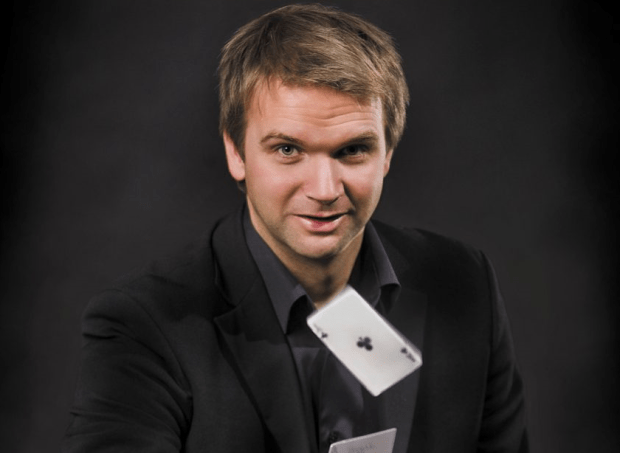
PETE FIRMAN: MARVELS

Pete Firman describes himself as a “comedy magician”, and it is his balance of comedy and magic that set Marvels apart.  Firman’s comedy does not feel like filler in between magic tricks, but like an equally valuable and sizable component of his show.

One highlight epitomizes this balance.  Firman uses a gigantic deck of cards for this section of the show, which he shuffles and then has an audience volunteer cut at random.  However, rather than then proceeding with a magic trick as the audience might reasonably expect, Firman tells a fantastically pun filled story based on the order of the cards in the deck.  This balance proves to be characteristic of Firman’s performance.

In a more magical sequence, Firman gets a couple of audience participants to join him on stage while he borrows a ring from one of them to use in his tricks.  While he could be a bit kinder to his audience participants, luckily the individuals who he had onstage seemed unfazed.  Firman performs his ring tricks with skillful precision, and an impressive degree of personal flair.

Firman unapologetically takes another break from magic when he uses a physics demonstration to mix drinks.  The principle is simple enough, and Firman’s attempts to build tension may seem especially overly dramatic to audience members who had enthusiastic physics teachers.   It is all the more impressive that Firman is able to seamlessly integrate such an experiment into his show, in a manner that does not feel out of place or any less entertaining to the audience.

Firman delves into classic magic as well, in particular in his utilization of two nesting tubes.  Callbacks to classic magic tricks continue with the materialization of a multitude of scarves.  Firman puts his own twist on the old tropes, and his distinctively idiosyncratic personality ensures that the tricks do not feel too old fashioned.

Marvels could be billed equally accurately as a magic show with bits of comedy, or a comedy show with bits of magic.  Firman is an exceptional performer in either genre, and watching him blend the two is a delight.


Pete Firman can be found at Pleasance Courtyard during the 2018 Edinburgh Fringe at 20:00 from August 6-26

More information on Pete Firman and his performance dates can be found here

SEAN HARRINGTON: SELF DECEPTION

Perceptual manipulation is an inherent component of magic, but is rarely discussed in any depth in magic shows.  Sean Harrington’s Self Deception is a well assembled show that highlights several of the facets of psychology that are especially relevant to magic.  This does not come across as a psychology lecture, for better or for worse, as the emphasis is decidedly on the magic tricks.  Nevertheless, the psychological themes prove effective at creating a structure for Harrington’s magic.

In one of his opening sequences, Harrington uses coin tricks to illustrate inattentional blindness, perhaps more famously illustrated in the experiment involving basketball players and a gorilla that Harrington cites as inspiration.  These are well performed, and easily engage the attention of even the children in the audience.

Harrington frames another trick as a tribute to the discredited science of phrenology.  While the way in which he “uses” phrenology is not really how phrenology works, this is perhaps forgivable as phrenology does not actually work, a fact with Harrington makes sure to state to his audience.  It does, however, work as a fun framework in which Harrington performs his tricks.

There is room for improvement in Harrington’s performance.  His magic tricks are skillfully done, but he might work on his use of the time between tricks, which does occasionally fall a bit flat.  This is especially noticeable in his final trick, which requires some length of preparatory work prior to the big reveal.  Harrington gets the audience involved in this stage, but it does still feel like the dull necessary procedure to reach the exciting conclusion, rather than an integrated and entertaining component of the show.  Performing well through these transition times is key to creating a cohesive show out of a collection of tricks.

In Self Deception Harrington has put together a fun set of magic tricks, which do for the most part fit in well with his psychology theme.  Harrington interacts well with an audience of mixed ages.  While there are elements of Harrington’s performance that could definitely do with more polish, his creative use of his theme has enabled him to design an interesting magic show.


Sean Harrington can be found at La Vida Room 1 (Venue 113) during the 2018 Edinburgh Fringe at 19:30

More information on Sean Harrington and his performance dates can be found here

INTERVIEW WITH AARON CALVERT

Aaron Calvert sat down with us after his show Declassified to talk a little about hypnotic suggestibility, his television show, and the pressures of performing at the Fringe.

Hannah: What got you into hypnosis?  What made you decide this is what you want to dedicate your life to?

Aaron: I got into hypnosis at 15, I saw a hypnotist onstage and around the same time I saw Derren Brown. I was interested in magic and being onstage and performing, so I started to read up on it, started to research it, try and practice it.  Then, I worked in America when I was 18, at a summer camp. They knew I was interested in this area and said “Hey, why don’t you put on a show for us?” I was hesitant, I was like, “…..ohh, okay…? Sure?” but I did and 35 people showed up and it was an amazing show and just worked. Then I went to med school, and I did hypnotherapy on the side, it was part of my medical degree, and I was kinda left with two choices at that point- either I could go full time into medicine or I could go full time into entertainment. And I couldn’t do both, because, if a patient walks in at 5 o’clock when you have a show at seven, it doesn’t really work out. So I just had to go with my heart, and hypnosis and performing in general are where my heart laid, so that’s exactly what I went for.  

So does the medical side of hypnosis interest you, or just the entertainment aspects?

It does interest me. I combine the techniques I learned from hypnotherapy and the techniques I’ve developed onstage for myself, to make the approach I have. I think that’s…it’s not revolutionary, but it’s different that what most hypnotists do, either they’re very much stage entertainment or they’re very much hypnotherapy. Whereas I combine both of those and because of that I get a really good response to the hypnosis. As you saw tonight, there were a lot of the people in the audience I could have chosen and I got fantastic suggestions on stage because of that.

Can you talk about hypnotic susceptibility? Some people say no one can be hypnotized if they don’t want to, and others say everyone can be hypnotized?

Sure, well I think they’re two sides of the same coin basically. You’ve got some people who say you can’t be hypnotized if you don’t want to be, and that’s absolutely true. And the other side of it is that everyone can be hypnotized. And yes, everyone can be, but if you don’t want to be you won’t be. Some people are amazing subjects, and like in my Channel 4 show, we had to go out of our way to find incredible subjects who were highly suggestible that would work and would be able to let me erase their memory each time. At the other end of the spectrum you’ve got people who are just open to some suggestion, and we might not ever be able to do something like erase their memories but they may well experience something like their foot being stuck to the floor, and that’s it. So you’ve got a spectrum of suggestibility. There is a moment when you’re being hypnotized by someone when you choose to go with them. If you go with it, it’s an incredible experience. But some people resist it and it doesn’t work.

What’s your opinion on the suggestion that most participants at a stage show aren’t actually hypnotized in the strictest sense, but playing along because they’re onstage? Do you think it matters?

I think it matters a lot for my show. I don’t necessarily think it matters a lot for comedy shows, where by someone wants to get onstage and might happily follow the instructions to dance with a mop or whatever that suggestion may be. In my show I invite the whole audience to participate, I go out to the audience, and I purposefully test them. They don’t know what I’m looking for, so I can tell when someone might be faking, and I test them to make sure I get the most suggestible people onstage. Because the things I ask people to do, they wouldn’t be able to do properly if they were faking. And it’s so important. Each of the participants, every one of them, does something incredible. And if any one of them was faking it, it wouldn’t work, and it would be very obvious, and it would become very awkward. That to me- I’d hate to have that be the case in my show.

What’s the most stressful thing about performing?

You know, I get asked this a lot, and I don’t tend to get nervous before a show until I am side stage and I hear the video intro play, and suddenly I’m like “Oh my god, why do I do this to myself.” But the moment I step onstage the nerves are gone, the moment I open my mouth, on that stage, there are no nerves, I’m just having fun. When it comes to fears for performing, the first week of the Fringe is what terrifies me. I don’t get nervous before doing a corporate event or even a stage show in Manchester or anywhere else, but coming to Fringe, I know there’s so much to do. Fringe audiences are tough. They won’t let you get away with it if you’re rubbish, and so the first week of the Fringe is probably my most scary time of the year, and then I settle into it and I just enjoy the rest of the run.

What’s the most exciting?

It’s got to be sharing an experience with people. I want people to leave my show having had an experience that they will take away and talk about with their friends and their family. I don’t really care if they remember my name, but as long as they were in some way moved or left with something to think about and talk about from the show, that’s my job done, that’s great, that’s entertainment. It’s not about ego, it’s not about me, it’s about the audience experience. And if the audience are having the best time, the most exciting thing for me is seeing that response.

And now you have a TV show, Hello Stranger. What was your inspiration there?

That tv show came about through the production company that had an idea that was based on Eternal Sunshine of the Spotless Mind, where two people have their memories erased. And they approached me with basically, ‘was it possible to erase one’s memory’ and I was like, yes, depending on how long and what for. And so we started to develop this idea and eventually came up that we wanted to have a couple and we wanted to have them erase their memories of each other and then go on a date. So the inspiration come from two points, one, the film, and two, the idea of giving a couple the chance to meet for the first time again. And getting them to meet each other, that’s what it’s about. It wasn’t about sending them on a date or getting them to break up, it was about getting a couple to meet and fall in love all over again.

Did it turn out the way you expected?

Yes. It did and it didn’t. I loved working on the show. What was brilliant was stuff that happened off camera that reaffirmed for me that everything that was happening in this experiment was genuine. The thing I didn’t like was that a lot of people called fakery on it. Which is natural with a hypnosis show and I think it was because we didn’t quite display all of the moments of genuine interactions we had that happened off camera. I’m very happy with the program, I’m happy that it’s out, I’m happy that everyone got to see it. But I think it taught me we need to help people understand hypnosis more, help people understand what’s going on.

So what do you think you enjoy more, live performance or television?

I enjoy both for very different reasons. I enjoy the live because you’re instantly getting feedback from the audience. So I know, if the audience don’t like something or don’t react to something at one point in this show, I can change it up again, that the audience can leave having the best show. And it’s great that when you see it live, you can’t call bullshit, because what is happening is happening to you, or is happening to your friend. That’s what makes television difficult, because they’re not there and can just say ‘oh they’re just stooges’. But what I love about television is that you can do things that take three days, or two years of planning, and bring it out, and put it on for such a wide audience. So I enjoy television because it allows us to do much bigger things, and I enjoy the live shows because you get to interact with people.

There are hundreds of shows at the Edinburgh Fringe. In one sentence, tell our readers why Declassified is a must see.

If you want the opportunity to be involved, and see people demonstrate inexplicable feats live onstage, come to Declassified.


Aaron Calvert can be found at The Gilded Balloon at the Museum during the 2018 Edinburgh Fringe, at 18:00 on August 5-26

More information on Aaron Calvert and his performance dates can be found here

MAGICFEST GALA: FAST & FURIOUS

☆☆

MagicFest’s gala this year is themed Fast & Furious, and is notable for its scarcity of traditional magic.  The host is the one self-described magician of the ensemble—although, to be fair, he is joined on stage by an illusionist troupe.  This works to the gala’s advantage simply because inviting a wider range of entertainers allows for more options in putting together an interestingly varied show.

Kevin Quantum returns to host the gala.  Perhaps in acknowledgement of his status as the only traditional magician of the evening, Quantum does a fair amount of magic in between the main acts.  His assortments of tricks are a disjointed jaunt through the world of magic that keeps everyone well entertained in the transition times.  He has a considerate rapport with the audience, using a combination of volunteerism and random selection to choose the participants that join him on stage to ensure that as many eager viewers as possible get their chance in front of the crowd.

Like many magicians, Javier Jarquin’s act uses a lot of playing cards.  However Jarquin is not a magician, he is the Card Ninja, so rather than stealthily manipulating his cards he demonstrates methods for throwing them.  Despite his variety of throwing methods, this may get a little bit repetitive for some audience members.  Jarquin’s enthusiasm and audience interaction help him continue to engage them.

Tom Crosbie’s Rubik’s cube themed performance is next on stage.  His Rubik’s cube solves are fast, and his cheerful chatter of stories and facts—nearly entirely about Rubik’s cubes—matches the speed of his hands.  Crosbie creates different solve situations, alternately tossing his cube to the audience to get in mixed up and keeping it in his own hands to show off his quickest solution methods, to get the maximum mileage out of his single cube.

The illusionist company Magus Utopia splits their act, performing the first half directly before the interval and the second half at the very end of the gala.  This is an effective format for them in this particular show, both to increase the suspense of their story and ensure that their numbers and theatrics do not overwhelm the other performers.  Illusionists are a staple of traditional magic, but Magus Utopia’s fantasy aesthetic aligns them with modern trends in popular culture, and the emphasis on the plot of their act gives new life to old magic tropes.

The audience returns from the interval to MC Hammersmith, a freestyle rapper comedian.  Such a large proportion of his spoken comedy relies on stereotypes that this does make his act occasionally feel outdated, despite his youthful appearance.  However, his freestyle rapping is exciting to witness, as he creates connections between random audience suggestions incredibly rapidly while maintaining the rhythm of his rap.  The improvised comedy of his raps is creative and fresh.

The final performer of the gala is James Freedman, a professional pickpocket.  His skilled demonstration of pick pocketing techniques was enhanced by one of his audience participants, whose absolute astonishment at seeing his possessions in Freedman’s hands gave the rest of the audience a glimpse into what it might feel like to have their pockets picked so thoroughly by Freedman’s nimble fingers.  Freedman proves his mental as well as manual dexterity in an impressive identity theft bit that feels fittingly akin to a magic trick.

MagicFest’s Fast & Furious gala includes an admirable assortment of acts over the course of the production, and it draws strength from this variety to build a lively show.  The diversity of the acts ensures that there is something for everyone.

THE SECRET ROOM AT LAURISTON CASTLE

☆☆☆

MagicFest’s Secret Room events are fantastic, as the chosen venues lend a theme to the performances, and the addition of the historical lessons of the buildings ensure that the evening is about more than magic.  This second point is especially true for the Secret Room at Lauriston Castle.  The event features three magicians, but the castle itself is the fourth star of the show.

The audience is first led into the study, where Billy Reid begins the evening’s magic.  Reid is perhaps the most true to theme.  Inspired by a historical cabinet maker who lived at Lauriston Castle, he incorporates a wooden puzzle into his act, and he concludes with a coin trick inspired by the lost coin collection of one of the castle’s former residents.  Reid’s gorgeous illustrated card trick sequence set to “Caledonia” is a highlight, working particularly well in this smaller venue.

The drawing room of the castle barely contains the boisterous character of Ian Kendall.  His tricks are classic, featuring cups and balls or ropes and rings, but his jokes keep the audience laughing, and his rapport with the group draws everyone into the performance.  Kendall does integrate a bit of a history lesson in to his act, and expresses suitable admiration for the room that he is performing in, but only very tenuously links his tricks to the history of the venue.  He makes this work as his larger-than-life personality easily distracts the audience from any thematic absence.

Chris Cook concludes the performances of the evening in the castle’s library.  The tidy precision of Cook’s magic style is exceptionally effective with this smaller audience.  In keeping with the theme, Cook uses an audience participant’s phone for his final trick, because, as he explains, these days the internet serves a similar purpose that a library would have back when Lauriston Castle was built.   While this does run in to technical difficulties, Cook maintains the momentum of his performance to deliver his reveal.  It is perhaps all the more impressive for the unplanned extra suspense.

Cook’s performance brings the magic of the evening to a close, but the audience is lucky enough to have the opportunity to stick around for a quick tour of the remaining rooms of the castle.  This includes two real secret rooms hidden in the performance venues.  As the event begins with a brief re-telling of the story of the castle and ends on this tour, the actual magic shows feel surrounded by history.

Lauriston Castle is an incredible venue for this Secret Room event, and the magic matches the excellence of the architecture.  The assortment of magicians is well chosen, as their contrasting styles ensure that each of their performances feels distinct, and the contrast makes the event feel balanced.  The castle and illusions combined ensure a wonderful evening steeped in all the best history and magic Scotland has to offer.

VINCENT GAMBINI – THE CHORE OF ENCHANTMENT

☆☆☆☆☆

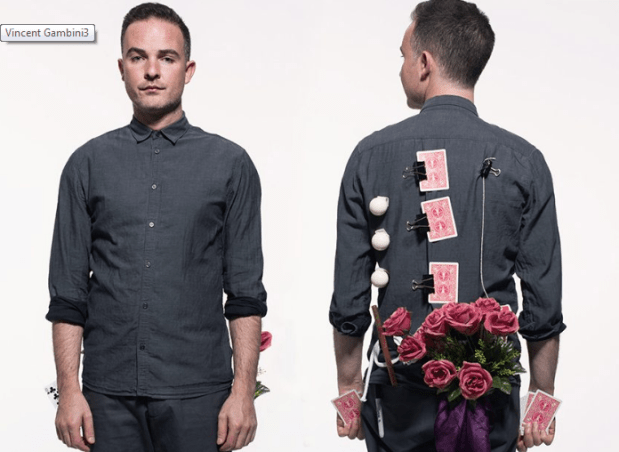
Vincent Gambini’s meta-show about magic, The Chore of Enchantment, encapsulates the pessimism of 2016.  It is especially fantastic for those who still haven’t quite gotten over the ridiculous politics of that year.  Most of The Chore of Enchantment is less magic and more Gambini’s stand-up comedy style routine about his disillusionment with both magic and the real world, with bits and pieces of tricks used to enhance his monologue and illustrate his descent into melancholy.

Gambini creates a sense of unease from the start as he steps on to the stage in a sleep mask, and describes the room, the audience, and himself as figments of his dream.  While the big illusions that he describes do not manifest—no floating yoda or hole in the fabric of reality appear on the stage—the card tricks that do are still enjoyable, and create a bridge between Gambini’s mind and reality.

Equally atmospheric are the smaller bits of magic that Gambini performs as he gets into the politics of his show.  Gambini makes coins and balls disappear and reappear as he talks about the repetitiveness of performing magic, and brings magic back to the forefront of the narrative when he makes a staff appear with a loud snap.  He does occasionally run the gag for a little bit too long, but this feels like part of the show, as it periodically transitions the audience from awe to near-apathy with each new effect.

Gambini’s interactions with his audience are charming.  He does not use a lot of participants, due to the relative scarcity of magic in his show, but he reacts remarkably well to their mistakes and interruptions, seamlessly working them in to his performance.

By its nature, The Chore of Enchantment does occasionally feel a little bit pretentious in its exaggerated self-consciousness.  Gambini pokes fun at his past career in conventional magic as inadequate given the current state of the world, while performing what is, at its heart, a magic show in his own attempt to come to terms with those real issues.  In spite of its stated conclusions that magic is simply another distraction, the effectiveness of The Chore of Enchantment is evidence in support of magic’s usefulness as a tool for performers to address real world issues.

In The Chore of Enchantment, Gambini balances entertaining his audience with inspiring them to think, both about the real world and the nature of entertainment.  His comedy still feels timely two years after the events that he discusses, and his minimalist magic augments his words and astonishes his audience.


More information on Vincent Gambini and his performance dates can be found here

RENZ NOVANI: POET OF THE IMPOSSIBLE

☆☆☆

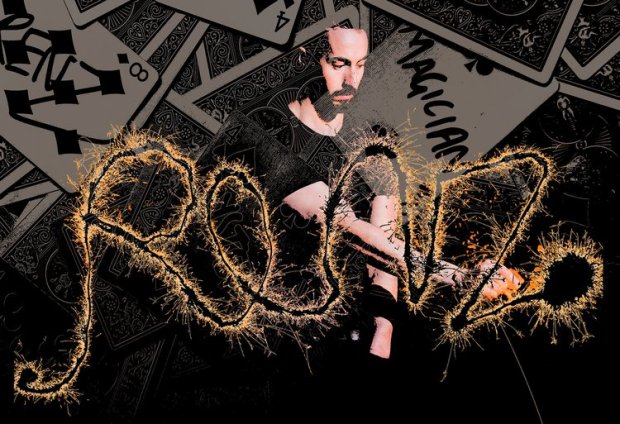
For a magic show, Poet of the Impossible is curiously light on magic, at least in the illusions sense.  Renz Novani’s poetry and storytelling share the spotlight with his magic tricks.  It is clear from the beginning that this is because Renz is a compelling performer, both with and without his magic. It does mean that his show might feel exceptionally niche—his best audience will be those who enjoy both magic and poetry—but those boundary-defying qualities also lend him a wider appeal, as a performer first and foremost over his role as a poet or magician.

In a fun twist on classic playing card trickery, Renz frames an opening trick by talking about his early days of learning magic out of books, and then having an audience participant read instructions from a magic book to guide him through a trick.  The audience feels as if we are taking part in this childhood anecdote.  But of course the instructions that are read out are incomplete, and the audience is still amazed to see the trick succeed.

Renz ventures into less conventional magical props with his use of tarot cards for a mind reading trick.  He does briefly use them for their intended purpose, while acknowledging that he himself is not a believer in such fortune telling.  When he finishes by using the tarot cards to reveal his mentalist trickery he dazzles the audience on his own terms rather than those set by the cards that he is using.

Poet of the Impossible winds down show by Renz telling stories about magic while performing the magic that he describes.  In one he describes a childhood dream about fairies fixing his broken toy while fixing it on stage in front of the audience.  He uses this to then draw a parallel between dreaming and watching magic, with both allowing for temporary escape from reality.

Renz’s graceful magic combined with his spoken word performance gently reshape his audience’s perception of reality while keeping us grounded in the real world.  While fans of both magic and poetry might get the most out of Poet of the Impossible, the elegance of his performance is enchanting to all.


More information on Renz Novani and his performance dates can be found here

BILLY REID – STORYTELLER

☆☆☆

In Storyteller, Billy Reid structures his performance around stories from his childhood, using magic to illustrate them and bring them to life.  “Illustrate” is perhaps the key word here, as aside from being incredibly well performed, Reid’s magic tricks are more often than not exceptionally aesthetically pleasing.

Reid sets this tone from his first card trick.  He starts it classically enough, with an audience participant picking a card that Reid then shuffles back in to his deck, but when the cards start changing to match the story that Reid tells, the fact that in the end he successfully finds the right card is actually the least exciting part of the act.  The artistic trend continues in Reid’s mentalist tricks, as he reads a volunteer’s mind by painting the scene that she is thinking of on a canvas on stage, his firm and decisive brush strokes keeping the audience engaged in trying to work out the final image.

Like all of this year’s solo shows at MagicFest, Storyteller is performed at the Scottish Storytelling Centre, and one of Reid’s tricks in particular would not look out of place in one of their exhibitions.  Reid uses a blank card deck that he has illustrated himself to tell the story of his love for Scotland in a trick that showcases both his magical and artistic skills.  This is a particularly inventive highlight of Reid’s beautifully creative show.

Reid’s tricks rely on audience participation just as much as any other magician’s, but Reid is notable in that he invites volunteers to step forward before randomly selecting a participant himself.  While both approaches have their merits, Reid’s worked for him in that his volunteers were visibly excited to participate, and the shyer members of his audience were presumably a little bit less stressed.  It is certainly more enjoyable to watch audience participants who participate enthusiastically.

Storyteller is a gorgeous production.  One of the personal details that Reid shares is that as a child he was passionate about his art classes, which is no surprise to his audience after seeing this show.  Reid smoothly combines his illustrative and performance skills into a remarkable experience.


More information on Billy Reid and his performance dates can be found here

WIZARD WORLD GATHERING

☆☆☆

MagicFest’s Wizard World Gathering has incredible potential as an event.  Harry Potter is obviously hugely popular, and magicians are ideally suited to bring the magic of Harry Potter into the muggle world.  There are certainly elements of the Wizard World Gathering that rise to the occasion.  The décor is incredibly detailed, the food and drink vendors have an admirable commitment to the theme, and framing the magic shows as “lessons” is an excellent way to create Hogwarts magic from stage magic.  However, the magicians themselves do not feel consistently committed to the Harry Potter theme, preventing it from being a cohesive event, and a few issues in the arrangement of the night detract slightly from its success.

The magic shows begin with R Paul Wilson’s “Expert Magic”.  From the start this is an outlier to the claimed theme, lacking in relevance to Harry Potter.  But to his credit, Wilson’s act itself is suitably entertaining; displaying his range of coin tricks and pickpocket-based card tricks.  Wilson may have misjudged the venue when planning one of his final tricks, which features him and several volunteers seated around a table.  Due to the layout of the theatre this is difficult to see, even from the middle of the audience.  The final effect is nevertheless impressive.

Kevin Quantum’s “Levitation Demonstrations” has an appreciably more Harry Potter theme.  Quantum takes a science fiction approach to this fantasy world, framing his show as his quest to discover a scientific means to levitate.  One of his tricks involving audience volunteers is really more of a trust exercise than a proper magic trick, which makes it all the more remarkable that Quantum is able to seamlessly include it in his act.  Quantum’s act feels less like a collection of tricks and more like a coherent theatrical production, with an admirable blend of his own magical style with the theme given to him.

“Time Travel 101” with John Henry Blackwood unfortunately often feels more hindered than helped by its theme.  Blackwood spends an inordinate amount of the middle of his act on a trick involving a toy plunger that is charming enough in and of itself but is only very loosely related to his own time travel concept.  However, he begins and ends with tricks that do genuinely use his theme to enhance the overall effect.  The stickers on the trunk that he uses as a table and the deathly hallows charm on his clothing are a lovely nods to the aesthetic of the evening.

Magic aside, there are a few issues that came up with the Wizard World Gathering itself.  As attendants enter the Assembly Roxy they are handed tickets with a couple of timings of the magic shows, but it is not explained that it is necessary to bring the ticket to that show time to be guaranteed a seat.   Many who were new to MagicFest took these timings as suggestions or reminders, and in the absence of an official explanation it fell to those who had attended previous similar MagicFest events to explain the system.  Also, in spite of the online description of the event as a party, the event really still feels like a series of magic shows.  Not necessarily a bad thing, but not what one is led to expect. There are few other activities in the central hall, and some are unexpectedly shut over an hour before the end of the event.  Additionally the Harry Potter quiz, while fun, could have done with a few more challenging questions.

That being said, the attention to detail in the decoration of the venue is absolutely fantastic.  The central hall is decorated as the Great Hall, and includes an intricately set up photo backdrop.  The common room, where the quiz is held, features a wall papered in book-print, and the bathroom even includes a snake sticker by one of the taps.  These details create a delightful atmosphere that is a highlight of the event.  Creating the right atmosphere is so crucial to events like this one, and for its flaws there are moments when attendees at the Wizard World Gathering feel truly transported to Hogwarts.

LEWIS BARLOW – CARDS, COINS & MINDS

☆☆☆☆

Lewis Barlow chose a very straightforward name for his show—Cards, Coins, and Minds—and he does exactly what it says on the tin, performing a series of coin and card tricks and reading a few audience members’ minds.  The premise is simple, but the magic is enthralling.  Barlow performs to an audience comprised largely of adults accompanied by young children, and he easily holds the attention of all ages.

Barlow begins with a quick few coin tricks.  While these are entertaining enough, a few of the younger children were still a bit fidgety until he brought out the cards.  Using a younger audience member as one of his first participants was both a nice way to include that segment of the audience and perhaps helpful in getting them on board with sitting still for the rest of the show.

Following this is his mind reading, where Barlow continues to excel.  He has mastered the art of timing his preparatory work just long enough to build anticipation while not continuing so long that he loses the attention of the children.  He uses both cards and less traditional magic props to maximize effect, and finishes up with a wonderfully performed déjà vu themed card trick that leaves the audience amazed as we exit the theatre.

If there is one critique to be raised of Barlow’s performance, it is in his poor handling of young child shouting out that she wanted to have a go at volunteering in his show.  Considering his experience (Barlow has been a magician for twenty years, he tells the audience in this show) one might have expected him to have contingency plans prepared for audience interference.  Seeing this instance apparently catch him unawares was especially surprising considering how well he otherwise dealt with his younger audience members.

In Cards, Coins, and Minds, Barlow’s performance is both pleasantly straightforward and captivatingly complex.  Barlow’s gentle stage presence inspires audience trust, and his evident magical skill enchants the audience.  Cards, Coins, and Minds is an excellent piece of family magic to entertain guardian and child alike.


More information on Lewis Barlow and his performance dates can be found here