4 Stars

PETE FIRMAN: MARVELS

Pete Firman describes himself as a “comedy magician”, and it is his balance of comedy and magic that set Marvels apart.  Firman’s comedy does not feel like filler in between magic tricks, but like an equally valuable and sizable component of his show.

One highlight epitomizes this balance.  Firman uses a gigantic deck of cards for this section of the show, which he shuffles and then has an audience volunteer cut at random.  However, rather than then proceeding with a magic trick as the audience might reasonably expect, Firman tells a fantastically pun filled story based on the order of the cards in the deck.  This balance proves to be characteristic of Firman’s performance.

In a more magical sequence, Firman gets a couple of audience participants to join him on stage while he borrows a ring from one of them to use in his tricks.  While he could be a bit kinder to his audience participants, luckily the individuals who he had onstage seemed unfazed.  Firman performs his ring tricks with skillful precision, and an impressive degree of personal flair.

Firman unapologetically takes another break from magic when he uses a physics demonstration to mix drinks.  The principle is simple enough, and Firman’s attempts to build tension may seem especially overly dramatic to audience members who had enthusiastic physics teachers.   It is all the more impressive that Firman is able to seamlessly integrate such an experiment into his show, in a manner that does not feel out of place or any less entertaining to the audience.

Firman delves into classic magic as well, in particular in his utilization of two nesting tubes.  Callbacks to classic magic tricks continue with the materialization of a multitude of scarves.  Firman puts his own twist on the old tropes, and his distinctively idiosyncratic personality ensures that the tricks do not feel too old fashioned.

Marvels could be billed equally accurately as a magic show with bits of comedy, or a comedy show with bits of magic.  Firman is an exceptional performer in either genre, and watching him blend the two is a delight.


Pete Firman can be found at Pleasance Courtyard during the 2018 Edinburgh Fringe at 20:00 from August 6-26

More information on Pete Firman and his performance dates can be found here

AARON CALVERT: DECLASSIFIED

Aaron Calvert has chosen a timely theme for his new Fringe show, Declassified. As Calvert explains in his opening remarks, on his inauguration, Trump declassified vast archives of information about some of the United States’s quirkier Cold War era research projects. Calvert’s jokes at Trump’s expense ensure that his audience knows that he is on the right side of history. The rest of the show is framed as an exploration into these declassified archives.

An early segment of Declassified features a classic mind reading trick using several cards with a range of simple shapes. This fits neatly into the Cold War theme. The story often told alongside these props is that they were used by the CIA to study subjects’ mind reading capabilities during the Cold War, and that when the Cold War ended and these research projects were disbanded several subjects used the same cards to demonstrate their skills in magic shows. Calvert puts his own stamp on this classic by adding a hypnotist twist.

Calvert soon shifts into the more hypnotism-centric part of the show, attempting to put the entire audience into a hypnotic state in order to find the best participants for the evening. The process is pleasantly relaxing, even for those who do not reach a full hypnotic trance. A selected few of those who do make it to that state are brought onstage to demonstrate the depth of their hypnosis. Unlike the seedy hypnotist stereotype, Calvert is respectful and empathetic toward those who he has successfully hypnotized.

Here Calvert shifts from his stated theme of the recently declassified files that he discusses at the start of his show, and spends more time relating his demonstrations to modern urban legends. Cold War enthusiasts may be disappointed. However, Calvert’s interpretation of this theme is ultimately uplifting. Rather than re-create the experiments of the Cold War era, Declassified is a new experiment designed to demonstrate the same theory, that individuals are capable of extraordinary feats.

If there is a criticism to be leveled at Declassified it is precisely that, its title. The titular declassified documents feel underused, as they are hardly mentioned beyond the opening political quips. The link between the Cold War theme and the later segments of the show is muddled with Calvert’s increasing reliance on modern urban legends to bring thematic structure to his demonstrations. Declassified would perhaps be better described by a title that evokes urban legends in general rather than one evocative of such a specific aspect of history.

Declassified succeeds as an impressive display of hypnosis, and is enhanced by Calvert’s optimistic attitude toward his audience. Calvert’s style of hypnotism comes across as benevolent rather than manipulative, as he proves his power over his hypnotized participants by compelling them to perform exceptional stunts rather than pointlessly embarrassing actions, while still putting on an entertaining show for his audience. Calvert’s refreshing take on hypnosis makes Declassified well worth the visit.


Aaron Calvert can be found at The Gilded Balloon at the Museum during the 2018 Edinburgh Fringe, at 18:00 on August 5-26

More information on Aaron Calvert and his performance dates can be found here

THE SECRET ROOM AT LAURISTON CASTLE

☆☆☆

MagicFest’s Secret Room events are fantastic, as the chosen venues lend a theme to the performances, and the addition of the historical lessons of the buildings ensure that the evening is about more than magic.  This second point is especially true for the Secret Room at Lauriston Castle.  The event features three magicians, but the castle itself is the fourth star of the show.

The audience is first led into the study, where Billy Reid begins the evening’s magic.  Reid is perhaps the most true to theme.  Inspired by a historical cabinet maker who lived at Lauriston Castle, he incorporates a wooden puzzle into his act, and he concludes with a coin trick inspired by the lost coin collection of one of the castle’s former residents.  Reid’s gorgeous illustrated card trick sequence set to “Caledonia” is a highlight, working particularly well in this smaller venue.

The drawing room of the castle barely contains the boisterous character of Ian Kendall.  His tricks are classic, featuring cups and balls or ropes and rings, but his jokes keep the audience laughing, and his rapport with the group draws everyone into the performance.  Kendall does integrate a bit of a history lesson in to his act, and expresses suitable admiration for the room that he is performing in, but only very tenuously links his tricks to the history of the venue.  He makes this work as his larger-than-life personality easily distracts the audience from any thematic absence.

Chris Cook concludes the performances of the evening in the castle’s library.  The tidy precision of Cook’s magic style is exceptionally effective with this smaller audience.  In keeping with the theme, Cook uses an audience participant’s phone for his final trick, because, as he explains, these days the internet serves a similar purpose that a library would have back when Lauriston Castle was built.   While this does run in to technical difficulties, Cook maintains the momentum of his performance to deliver his reveal.  It is perhaps all the more impressive for the unplanned extra suspense.

Cook’s performance brings the magic of the evening to a close, but the audience is lucky enough to have the opportunity to stick around for a quick tour of the remaining rooms of the castle.  This includes two real secret rooms hidden in the performance venues.  As the event begins with a brief re-telling of the story of the castle and ends on this tour, the actual magic shows feel surrounded by history.

Lauriston Castle is an incredible venue for this Secret Room event, and the magic matches the excellence of the architecture.  The assortment of magicians is well chosen, as their contrasting styles ensure that each of their performances feels distinct, and the contrast makes the event feel balanced.  The castle and illusions combined ensure a wonderful evening steeped in all the best history and magic Scotland has to offer.

RENZ NOVANI: POET OF THE IMPOSSIBLE

☆☆☆

For a magic show, Poet of the Impossible is curiously light on magic, at least in the illusions sense.  Renz Novani’s poetry and storytelling share the spotlight with his magic tricks.  It is clear from the beginning that this is because Renz is a compelling performer, both with and without his magic. It does mean that his show might feel exceptionally niche—his best audience will be those who enjoy both magic and poetry—but those boundary-defying qualities also lend him a wider appeal, as a performer first and foremost over his role as a poet or magician.

In a fun twist on classic playing card trickery, Renz frames an opening trick by talking about his early days of learning magic out of books, and then having an audience participant read instructions from a magic book to guide him through a trick.  The audience feels as if we are taking part in this childhood anecdote.  But of course the instructions that are read out are incomplete, and the audience is still amazed to see the trick succeed.

Renz ventures into less conventional magical props with his use of tarot cards for a mind reading trick.  He does briefly use them for their intended purpose, while acknowledging that he himself is not a believer in such fortune telling.  When he finishes by using the tarot cards to reveal his mentalist trickery he dazzles the audience on his own terms rather than those set by the cards that he is using.

Poet of the Impossible winds down show by Renz telling stories about magic while performing the magic that he describes.  In one he describes a childhood dream about fairies fixing his broken toy while fixing it on stage in front of the audience.  He uses this to then draw a parallel between dreaming and watching magic, with both allowing for temporary escape from reality.

Renz’s graceful magic combined with his spoken word performance gently reshape his audience’s perception of reality while keeping us grounded in the real world.  While fans of both magic and poetry might get the most out of Poet of the Impossible, the elegance of his performance is enchanting to all.


More information on Renz Novani and his performance dates can be found here
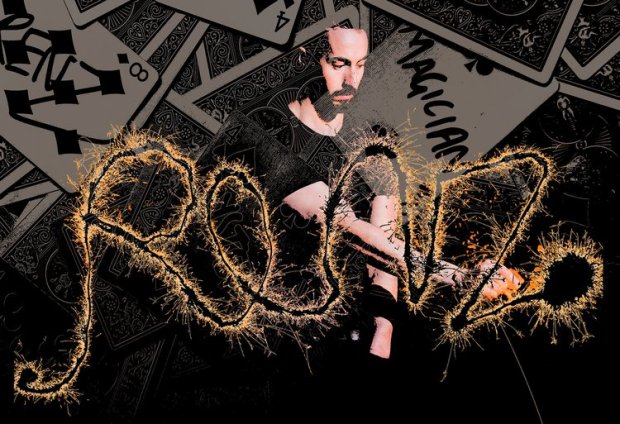
BILLY REID – STORYTELLER

☆☆☆

In Storyteller, Billy Reid structures his performance around stories from his childhood, using magic to illustrate them and bring them to life.  “Illustrate” is perhaps the key word here, as aside from being incredibly well performed, Reid’s magic tricks are more often than not exceptionally aesthetically pleasing.

Reid sets this tone from his first card trick.  He starts it classically enough, with an audience participant picking a card that Reid then shuffles back in to his deck, but when the cards start changing to match the story that Reid tells, the fact that in the end he successfully finds the right card is actually the least exciting part of the act.  The artistic trend continues in Reid’s mentalist tricks, as he reads a volunteer’s mind by painting the scene that she is thinking of on a canvas on stage, his firm and decisive brush strokes keeping the audience engaged in trying to work out the final image.

Like all of this year’s solo shows at MagicFest, Storyteller is performed at the Scottish Storytelling Centre, and one of Reid’s tricks in particular would not look out of place in one of their exhibitions.  Reid uses a blank card deck that he has illustrated himself to tell the story of his love for Scotland in a trick that showcases both his magical and artistic skills.  This is a particularly inventive highlight of Reid’s beautifully creative show.

Reid’s tricks rely on audience participation just as much as any other magician’s, but Reid is notable in that he invites volunteers to step forward before randomly selecting a participant himself.  While both approaches have their merits, Reid’s worked for him in that his volunteers were visibly excited to participate, and the shyer members of his audience were presumably a little bit less stressed.  It is certainly more enjoyable to watch audience participants who participate enthusiastically.

Storyteller is a gorgeous production.  One of the personal details that Reid shares is that as a child he was passionate about his art classes, which is no surprise to his audience after seeing this show.  Reid smoothly combines his illustrative and performance skills into a remarkable experience.


More information on Billy Reid and his performance dates can be found here

LEWIS BARLOW – CARDS, COINS & MINDS

☆☆☆☆

Lewis Barlow chose a very straightforward name for his show—Cards, Coins, and Minds—and he does exactly what it says on the tin, performing a series of coin and card tricks and reading a few audience members’ minds.  The premise is simple, but the magic is enthralling.  Barlow performs to an audience comprised largely of adults accompanied by young children, and he easily holds the attention of all ages.

Barlow begins with a quick few coin tricks.  While these are entertaining enough, a few of the younger children were still a bit fidgety until he brought out the cards.  Using a younger audience member as one of his first participants was both a nice way to include that segment of the audience and perhaps helpful in getting them on board with sitting still for the rest of the show.

Following this is his mind reading, where Barlow continues to excel.  He has mastered the art of timing his preparatory work just long enough to build anticipation while not continuing so long that he loses the attention of the children.  He uses both cards and less traditional magic props to maximize effect, and finishes up with a wonderfully performed déjà vu themed card trick that leaves the audience amazed as we exit the theatre.

If there is one critique to be raised of Barlow’s performance, it is in his poor handling of young child shouting out that she wanted to have a go at volunteering in his show.  Considering his experience (Barlow has been a magician for twenty years, he tells the audience in this show) one might have expected him to have contingency plans prepared for audience interference.  Seeing this instance apparently catch him unawares was especially surprising considering how well he otherwise dealt with his younger audience members.

In Cards, Coins, and Minds, Barlow’s performance is both pleasantly straightforward and captivatingly complex.  Barlow’s gentle stage presence inspires audience trust, and his evident magical skill enchants the audience.  Cards, Coins, and Minds is an excellent piece of family magic to entertain guardian and child alike.


More information on Lewis Barlow and his performance dates can be found here
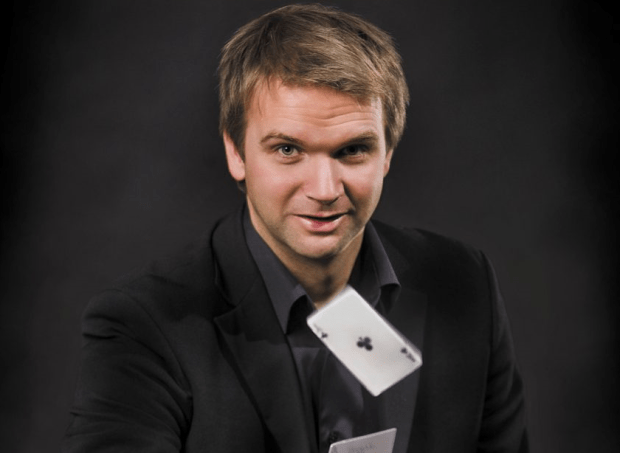
THE SECRET GIFT

☆☆☆☆

The stage at the Traverse Theatre sets the tone for the Magicfest Christmas Special “The Secret Gift” with a lovely silhouette of the Edinburgh skyline, featuring hanging lights appropriately reminiscent of the enchanted candles of Hogwarts.

The show is hosted by Kevin Quantum, who weaves Christmas cheer through the evening with his between-act entertainment.  His commitment to the Christmas theme in each of his appearances is admirable.  Quantum is at his charming best when interacting with his audience participants, and holds the attention of parent and child alike with his engaging misdirections.

The first act to take the stage is Chris de Rosa and his glamorous assistant in The Art of Illusion.  This act features many classic magical effects, with the two surviving a variety of seemingly fatal situations. This pair excels at coordinating their turns in the spotlight to support each other’s performances.  De Rosa and his partner return to the stage as the final act of the evening, with a more festively themed take on their signature style.  Their closing trick is a suitably playful end to the program.

Professor Kelso follows with a decidedly more comedic form of magic.  While his sleight of hand and mind reading clearly delight the audience, it is his fantastic character that keeps the audience laughing during his time on stage.  Kelso is the other performer who appears twice in the show.  His second performance is a break from the usual course of the show, featuring Kelso leading the audience in a sing-along of a Christmas carol that he has re-written to a magic theme.  This level of audience participation lends a pantomime atmosphere to this portion of the evening.

Another break in the usual course of magic comes from Señor Pérez, who is not a magician, but a bubble artist.  Neither properly magical nor especially Christmassy, Pérez’s bubble choreography is nevertheless enchanting.  His ephemeral creations prove truly captivating to watch.

The final magician, David Blanco, performs a series of card and coin tricks.  His decision to perform these tricks in a relatively large theatre may initially seem questionable, as both are more commonly performed for smaller audiences, but the dimensions of the theatre, and Blanco’s clever use of the largest coins available, means that his tricks are still relatively visible from the farther side of the audience.  The commendable scaling of close up magic for a larger audience in this act allows this show to demonstrate a wide range of magic styles.

The variety of acts in “The Secret Gift” makes for an exciting evening. The show seems especially popular with families with young children, and the performers successfully cater to the range of age groups in the audience.  The overarching festive cheer of this show successfully extends the magic of Christmas well beyond its usual temporal limits.

PBH BEST OF MAGIC SHOW

☆☆☆☆

The PBH’s Best of Magic show, hosted by Chris Cook, featured a different lineup of magicians at each of its three performances.  This review is of the third and final performance, and it was a fitting finale to a Fringe full of incredible magic.

Cook was the perfect choice to host this show.  His love for magic shone through each and every one of the glowing introductions that he gave his fellow magicians.  After watching him juggle getting the crowd excited for each act, helping out in various ways throughout the performances, and performing his own magic tricks when the occasion called for it, it is easy to see why Cook has found success in the hectic realm of performing at private parties.  His unflappable cheeriness at every juncture held the show together.

The show kicked off with Aaron Calvert, a mind reading magician whose main show culminates in hypnosis.  Here, with less time, he focuses on the mind reading, using an audience member to choose numbers on a die for him to figure out.  Calvert’s commanding presence kept the audience mesmerized by his feats.

Next up was the delightfully creepy Ava Beaux.  Her Edgar Allan Poe themed show was reviewed here on one of her first performances, and she has only improved over the course of her time at the Fringe—she certainly had plenty of performances in which to do so, as she proved to be so popular that she had to run her show twice a day to satisfy her fans.  Beaux’s performance persona had consistently been one of her strong points, and even that had developed further; she was fully committed to her darkly comic character.  Beaux is reminiscent (if she would permit a more modern comparison than Poe) of Lemony Snicket, of “A Series of Unfortunate Events” fame.  Her magic tricks were appreciably neat and polished, and she kept up the flow of her act to seamlessly incorporate her illusions.

Following Beaux came a properly comic interval, featuring Tom Crosbie.  Crosbie’s main show included a variety of mathematical and Rubik’s cube based comedy.  Here he focused on the Rubik’s cubes, showing off his quick solves, and tricks like solving the Rubik’s cube while it was in midair.  While Crosbie does not do what one would consider a quintessentially magic centered act, his set was entertaining and provided an interesting change of pace.

David Narayan came next, with his own take on mentalism. He also brought along a taste of the magical history lesson that featured so prominently in his main show, The Psychic Project.  Also similarly to his main show, he kept a twist for the end—which, in this case, featured an unusually exciting wardrobe change.  Narayan’s performances at this Fringe have been heavily informed by history, but it is such characteristic personal flourishes that truly set him apart.

The show wrapped up with a final set by Dave Alnwick, another magician who has proved incredibly popular this year.  His wallet-based trick, featuring multiplying yellow fluffy balls, was a fun and playful way to end the show.  Like in all of Alnwick’s performances, his charismatic personality kept the audience engaged regardless of what he was doing on stage.  As Alnwick is also an amazingly skilled magician, the audience was captivated.

This performance of the Best of Magic show featured a wonderfully skilled lineup and stellar performances from every entertainer.  Each one of these performers are exceptional in their own right, and watching them perform on the same stage was a delight.

#DAVE: LITERALLY THE BEST MAGICIAN

☆☆☆☆

Some magicians favour subtlety. Dave Alnwick is, unapologetically, not one of them. In one of his shows, he asks his audience to worship him, and in this, his “Literally the Best Magician” show, he seeks to prove that he has earned that title. “Literally the Best Magician” has had an incredible run so far at the Fringe, with daily queues down the street—the Voodoo Rooms even had to set a start time for the queuing, as people were turning up to see Dave well over an hour before the show’s start time.

Alnwick performs a huge variety of tricks to prove his magical superiority, from sleight of hand tricks to mental magic. A mentalist highlight from “Literally the Best Magician” is when he has volunteers draw on white boards and then matches up the drawing to the person who drew it. One of the constants across Alnwick’s performances is his incredible charisma. While many of his tricks are uncommon and intrinsically impressive, he does include a few of the more traditional ones in his bid for ultimate superiority. In his capable hands, these basics are just as engaging. Alnwick also consistently teaches his audience a few of the magical fundamentals, which is an enjoyable way for the audience to feel involved. In this case, he instructs us in some basic sleight of hand. Learning the principles involved only gives the audience a greater appreciation of Alnwick’s skills.

It is worth mentioning that the multi-talented Alnwick has written a choose-your-own adventure book, that also includes instructions to learn magic tricks, which he sells at the end of each of his shows. For Alnwick’s fans, his magic does not have to end when his show does.

Is Alnwick really “Literally the Best Magician”? Spectator chatter certainly swung in his favour by the end of the show. Members of his audience could be overheard comparing him favourably to Derren Brown. Ultimately the question is best answered by every individual for themselves, but it is definitely very enjoyable to watch Alnwick state his case. “Literally the Best Magician” does not try to tell a story, or inspire anything in its audience except for a love of Alnwick. But it is ridiculously fun to watch, and sometimes that’s exactly what you want.

More information on Dave Alnwick and his performance dates can be found here

CHRIS COOK: CONCEALED

☆☆☆☆

Chris Cook’s “Concealed” show, as per the title, is deliberately set in a cozy venue off the beaten Fringe path. Combined with the show’s low-key publicity, it sets an intimate tone for this afternoon act. Cook maintains this intentionally cultivated relaxed vibe throughout his series of street magic style tricks.

One of the reasons for this intimate show, Cook explains, is that several of his illusions are too physically small to be appreciated by the full audience in a large scale venue. Coin bending, one of the first tricks that he performs, is an obviously apt example of this. Audience members should perhaps be warned that when they lend Cook a coin they will not receive it back in working condition, but they do get a fun magical souvenir out of it, and Cook is kind enough to not use any volunteered pound coins for this particular effect. 

The small venue and audience size also allow Cook to perform an extended selection of card tricks. Exciting examples of these involve Cook producing a chocolate bar out of a brief flash of fire, and causing a deck of cards to disappear from within an audience member’s clasped hands. Cook ends with classic street magic sleight of hand, involving three cups and balls. Here his personal additions to the usual standards, and his use of the motifs of that trick to recall earlier moments in this show, make for an exciting finale.

“Concealed” is an ideal show to highlight the neatness and elegance of Cook’s magic style, some of which may get lost toward the back of a larger venue. It also allows Cook to engage more with his audience, as he performs magic surrounded by his viewers instead of up above them on a stage.

The choices that Cook makes in his different shows display his versatility as a magician, as they each have very different atmospheres and feature distinct aspects of Cook’s magical skills. For Fringe goers who are only able to see one of Cook’s shows (or perhaps even only one magic show) “Control” is the one to go to. However, for those with an extra hour to spend in Cook’s delightful company, “Concealed” is an engaging and entertaining option.


More information on Chris Cook and his performance dates can be found here