
stage magic

ANDREW MCKINLAY: PERSPECTIVE

☆☆☆

The titular theme of Perspective is mentioned briefly in Andrew McKinlay’s show, but not really well explored.  This appears to be intentional and probably for the best.  At the reviewed show he certainly didn’t get much of the kind of audience who would be willing to follow along with a big theme.  There are hints of a more thoughtful kind of show that McKinlay might have put together for a different time slot, that would definitely be of interest to see at a future Fringe. 

There will always be increasing numbers of drunk people at Fringe shows as the night goes on.  In Perspective Andrew McKinlay appears to have embraced his fate, as one of the later slots at a venue with a great drinks menu, of having to deal with high numbers of drunk people in his audience.  This is what is showcased of his skill set.  And the magic is nice too, it’s a solid foundation for McKinlay to use to corral the drinkers into a reluctant audience willing to cooperate with his show. 

McKinlay uses a variety of sleight of hand and mentalist tricks throughout the set.  These are performed well enough, certainly for the composition of the audience.  The crowd was especially fond of an effect early in the show, in which McKinlay invites a range of participants on to the stage to draw a face, after which he attempts to match the drawing to the individual who drew it.  It is perhaps indicative of the evening that the participants’ antics drew more of a reaction from the audience than McKinlay’s successful completion of the effect. 

As will be evident from the preceding paragraphs of this review, McKinlay faced a challenging audience at the reviewed show – weirdly drunk for a Tuesday evening and entirely unafraid to heckle frequently.  McKinlay handled them like the professional that he is.  It was actually difficult to gauge how disruptive the audience was while sitting in the show, as McKinley was so adept at responding to them and redirecting the audience’s attention that the progress of the show flowed smoothly around the many interruptions.  It is in hindsight that it is clear how hard he was working to make his show look so effortless. 

Perspective may not change the audience’s perspective of much.  But McKinlay knows what he’s dealing with and delivers a solid magic show, to amaze even the most drunk of Fringe-goers regardless of whether they want to be amazed or not. 

More information on Andrew McKinlay and his performance dates can be found here.

DAVE ALNWICK: EXCEPTIONAL MAGIC & SUPER CHILL MAGIC

☆☆☆☆

At an Edinburgh Fringe where many familiar magicians are absent or performing limited runs, Dave Alnwick is back for full Fringe long of three to five shows a day.  By numbers alone, he accounts for exactly one third of the magic listings on the PBH Free Fringe website this year.  His two daytime shows, Super Chill Magic and Exceptional Magic, are intentionally very similar to accommodate his many fans, which is why they are both best addressed in this one review. 

The household name status that Alnwick has achieved at the Fringe makes the audience experience at his shows extra special.  People who manage to secure spots at the fronts of his queues have the camaraderie of successful pilgrims, holding spots in the queue for strangers who have urgent errands and exchanging phone numbers so those who remain can immediately update the errand-runner if anything changes.  The hype might sound excessive but as soon as the show starts, Alnwick proves that he’s earned it. 

Both Super Chill and Exceptional Magic have a bit of sleight of hand but rely more heavily on mentalism, Alnwick’s specialty.  Everything is performed flawlessly, as his audiences have learned they can expect.  A card trick that he performs with two audience participants in each show is a particular highlight, with Alnwick leaving his deck of cards in the participants’ hands for the majority of the effect.  In the talent-scouting portion of the reviewed Super Chill Magic, Alnwick found an excellent participant who briefly stole the show, and would not be out of place on his own stage, perhaps at next year’s Fringe.  Choosing participants who will best enhance the show is a skill in itself, and one that Alnwick has clearly mastered over his long career. 

Super Chill and Exceptional Magic are well timed to accommodate Alnwick’s variety of fans.  Super Chill Magic is in the early afternoon, earlier than most shows, for the Fringe tourists to kick off a busy day of show-hopping.  Exceptional Magic, on the other hand, is just about late enough for locals to pop in after a day in the office, and to catch those unwilling to get out of bed in time for Super Chill Magic.  Both Alnwick and this reviewer agree that attendance at both is not necessary for any but the most devout of his followers.  Either one is sufficient to re-cement the legend of Alnwick in the Fringe collective consciousness for another year. 

More information on Dave Alnwick and his performance dates can be found here.
CHRIS CROSS: A PANDEMONIUM OF PARLOUR TRICKS IN A PANDEMIC

☆☆☆☆☆

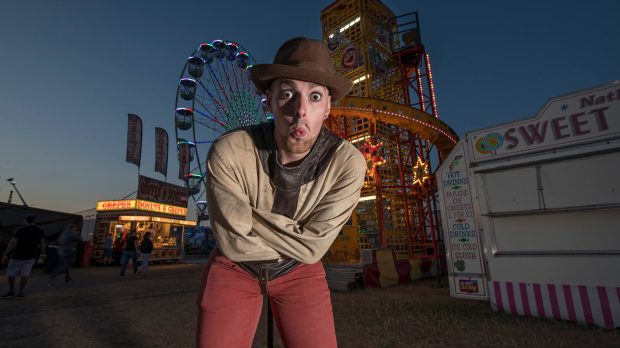
For those of us who haven’t heard of or seen him before, it is too easy to underestimate Chris Cross.  From the wacky name and monogrammed belt buckle, the aggressively arranged alliteration of his 2021 show title A Pandemonium of Parlour Magic in a Pandemic, to the line in his show description advising “NOT for the easily offended”, it’s easy to assume that he must be overcompensating for something.  Fortunately for his audience this is absolutely not the case.  Cross brings the magic to back up the swagger of his over the top character in a funny and interesting performance. 

Perhaps more impressive than any of the magic is how skillfully Cross manages to playfully poke fun at the audience without coming across as a bully.  It’s a tough thing to balance, if the many performers who are unable to do so are any indication, and Cross makes it look easy.  Of course in magic shows the audience is generally called upon to take a more active role, and Cross’s participants on the evening of this review were well chosen.  A cadre of Canadian students in particular rose to the occasion to perfectly match Cross’s energy on stage and enhance the show with their participation. 

Magicians often claim that they’ll show the audience tricks that they’ve never seen before, but his claim typically leaves those who have seen many magic shows feeling disappointed.  Cross, on the other hand, genuinely follows through with a series of tricks that this reviewer at least hasn’t seen before (and we at World Magic Review have seen a fair share of tricks).  This part of the show that is a bit of a history lesson is exceptionally fun to watch.  Cross’s enthusiasm for these weird old tricks that have long since fallen out of fashion breathes new life into the old props.  His style seamlessly blends the more standard card and escapist material with the tour of historic props, in a one man demonstration of the range and development of magical performance. 

Cross’s Pandemonium of Magic is a necessary stop at this year’s Fringe for anyone who has ever considered themselves to be a fan of magic, even if for no other reason than the historical interest of the old-fashioned props that he has brought back to the stage.  That being said there are plenty of other reasons to see his show, between his comedy, sleight of hand skills, and perfectly choreographed escapology.  It’s as difficult to pigeonhole his act as it is to keep him in a straitjacket, and his show is all the better for it. 

More information on Cross and his performance dates can be found here.
TRENT JAMES: PURE LIES

☆☆☆☆

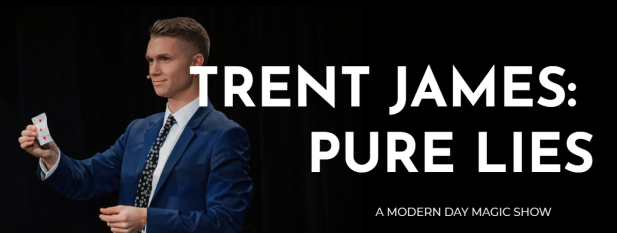
It cannot be underestimated what a boon the Chicago Magic Lounge is to the local magic scene. Within the flawlessly decorated interior, walls dripping with prints from the golden age of magic and hidden doorways at every turn, any performer is perfectly set up to shine. That being said, the brilliantly constructed beauty of the venue still would not be able to carry the show. For that, the magician still needs their own supply of skill and charm. Luckily for Trent James, he is well situated with both.

If you are the type to google your entertainers before you see a show, which increasingly we all are, you would note that James bills himself as a comedy magician. This may skew expectations, as Pure Lies is not what one would predict from such a claim. Comedy magic almost exclusively uses the trick as a tool to deliver the punch line, whereas James’ show is a far closer fit to a traditional magic show. Cheeky, self-depreciating humor sparkles under every line of banter, but is never made the focus of any bit, just a supplement.

More accurately, Pure Lies is well- performed, classic magic. James pulls from the best of old magic, but wisely avoids padding with any trick that is too worn out. Instead, he makes sure the tricks he does perform are given ample attention, molded around the ideal avenues for audience interaction, and refreshed to provide a modern take.

The unpretentious air that James affects may be the most clever part of Pure Lies, shrugging into the silliness of the show while perfectly disguising the hard work that magicians have to put in to seem effortless. The technical talent displayed by James is remarkable if you know to squint for it, and the fact that you have to squint a triumph on its’ own.

Chicago Magic Lounge seldom lacks for a good show, but Trent James’ Pure Lies stands out within their program as an unmissable event.

More information on Trent James and his performance dates can be found here. 

ALEX KOUVATAS: SOMETHING IS MISSING

☆☆☆

In a field where puns abound, Alex Kouvatas stands out as a master of their usage.  He sets the tone early in Something is Missing, bringing out the fish as promised.  Kouvatas is fantastic with his humour, charm with his audience, and in bringing his own take to his magic. However, he falters markedly in stitching the elements of his show together. 

Kouvatas performs a succession of magic and mentalist tricks, personalized to his style and performance.  His take on making an audience member’s money disappear is a fun example which he uses to bookend the show, but maybe even more fun is the fairly standard card trick which he adds his own ending to, preserving the magic for those who have seen the first part of the trick before.  He is warm with his participants, even explaining a pandemic-polite contact free hug at the end of a trick. 

Unfortunately Kouvatas struggles slightly, most notably in his transitions and confidence.  These two points of issue seemed to feed into each other, but as the show goes on, he appears to gain some confidence and transition more smoothly between tricks.  In addition, Something is Missing brings up interesting topics like dissonance between social norms of success and personal feelings of fulfillment that don’t get the time in the show to feel fully explored, but sound worth exploring. 

What seems to be is missing from Kouvatas’s show it is time and practice.  He suits the stage, shows an impressive degree of creativity in how he performs his tricks, and hints at an inclination to integrate broader themes in to his work.  He is certainly a magician to keep one’s eye on in the future.

Any Fringe debut is a huge achievement.  Making his Fringe debut during this weird pandemic Fringe must take an unbelievable amount of courage, for which Kouvatas deserves commendation.  And while his show could do with fine tuning, his wit and charm make him worth a visit this year.  

More information on Alex Kouvatas and his performance dates can be found here.

EDINBURGH MAGIC SOCIETY END OF SEMESTER CABARET

☆☆☆☆

Edinburgh University Magic Society’s End of Semester Cabaret was a showcase of the talented magicians that dwell among Edinburgh’s student body. With no overarching theme, the night was characterised by a diverse set of acts with close-up magic juxtaposed against larger stage shows. Regrettably, the evening was heavily delayed due to technical difficulties which unfortunately persisted throughout the show. Nonetheless, a close-up magician (who grew in confidence with each successful trick performed) entertained the audience and ensured the time passed quickly.

Comedic compare Alex De Koning entertained throughout the evening. His risqué jokes were well received by the student audience and De Koning’s charismatic personality ensured he dealt well with an array of magical mishaps, including a particularly difficult participant for one of his first tricks. De Koning’s persistence in the face of adversity paid off when his latter tricks were pulled off almost flawlessly. De Koning used his role well to highlight his large and diverse repertoire and ensured the audience looked forward to his inputs.

Matt Yocum had the tricky task of opening the show. Like De Koning, Yocum faced a difficult participant who he was unable to put at ease, which undoubtedly left the finale of his first trick falling a bit flat. Conversely, Yocum’s cups and balls trick was executed perfectly – no mean feat when the balls kept rolling off the make-shift table.

Chris Morningstar was the most bizarre and therefore the most memorable act of the evening. His act creatively pulled three seemingly unrelated aspects – maths, musicals and magic – into a comical and unexpected performance. Although also facing repeated technical difficulties, Morningstar breezed through his impressive stage magic tricks. Morningstar’s performance became repetitive towards the end, but in true rockstar fashion, Morningstar got the audience singing along with him, leaving the audience wanting more.

Most hindered by the technological difficulties was Leo Hotham whose act centred upon traditional close-up card tricks. With the input for the large projected back screen being a grainy webcam, unable to pick out the suits of the cards, the magic was slightly lost for those who were not in the front row. Although smooth-talking Hotham’s tried and tested lines will be well known to anyone who has seen a magic show before, his slick tricks were nonetheless impressive and well-executed.

Sean Harrington clearly had a large following in the audience, and given his remarkable performance, it is not difficult to see why. The only act to fully engage with the difficult double-tiered venue, Harrington’s showmanship was second to none. Although dangerous at times (perhaps throw coins away from rather than towards the audience in future!), Harrington performed arguably the most technically difficult magic of the evening effortlessly showing he is an incredibly skilled, traditional magician.

For a seemingly unrehearsed event, the Edinburgh Magic Society End of Semester Cabaret was an enjoyable showcase of diverse magic styles – it is definitely worth keeping an eye out for similar events by them in the future.


More information on the Edinburgh Magic Society can be found here.

AVA BEAUX: THE MYSTERIOUS TALES OF POE

☆☆☆☆

As the audience enters her venue, Ava Beaux appears to be incredibly sweet and welcoming, pulling over extra chairs to ensure that the sizable crowd who wish to see her show all manage to fit in the room. This is a comforting memory to cling to as The Mysterious Tales of Poe begins and Beaux’s eerie performance persona becomes increasingly unsettling.  Beaux holds the audience’s attention from the moment she silently starts cutting up a balloon string.  Her mesmerizing performance ensures that no one looks away even as the tricks get more macabre.
 

Nevertheless the audience feels a degree of safety, as all of Beaux’s creepiest effects and destructive impulses are focused on herself.  She is kinder to the participants who she calls upon to help throughout the show.  The magic itself is largely well performed.  If the odd prop is visible before it is meant to be the audience hardly notice or care as they are caught up in the flow of Beaux’s interpretations of Poe’s stories.
 

This is where Beaux truly excels, in the interweaving her storytelling with her magic.  Every trick supports the Poe stories that she narrates.  Likewise, each story is perfectly chosen as being suitable to be told through magic and further her theme, so the magic never feels forced.  The finale of her show is, however, entirely storytelling, and Beaux invites her audience to close their eyes to better appreciate Poe’s words, even at the expense of making her final reveal slightly anticlimactic.  Seeing the majority of the audience follow this advice is a testament to the degree of trust that Beaux manages to build in spite of the frightening nature of her performance.
 

The theatricality of The Mysterious Tales of Poe broadens its appeal; audience members certainly don’t have to be fans of magic to enjoy it.  On the other hand, those who are used to seeing magic performed as trick after trick with no unifying theme might gain a greater appreciation for the potential of magic when performed with Beaux’s creativity.
 

More information on Ava Beaux and her performance dates can be found here.
JOHN ACCARDO: METHOD TO THE MAGIC

☆☆☆☆

Magic can be many things, based on everything from the taste of the performer to the perception of the spectator. Magic can be challenging, exciting, classic, smug, one or any or none of the above but something else. But in John Accardo’s Method to the Magic, above all else, magic is joy.

Accardo is a wellspring of effusive, infectious enthusiasm. It is abundantly apparent just how much passion he has for magic, and how much delight he takes in sharing it. This devotion transfers more and more strongly to his audience the longer he spends with them.

Method the the Magic is a very casual show. Accardo chats with his crowd as they come in, banters easily, and makes no attempt to restore order when certain moments of audience participation dissolve into farcical levels of confusion and self consciousness. Rather, he leans into it, letting every moment develop naturally. This cannot and should not be mistaken for lack of control. Accardo is a sharper and more skilful magician than he’s willing to let his audience think he is. The silliness inspires goodwill for him in his spectators, and thus Accardo has won the crowd.

Accardo uses classic magic effects very well integrated into his narrative for the show- explaining what it’s like to be a magician and (almost, sort of) what it’s like to do the tricks. He jumps from mind reading to card tricks and beyond with equal and impressive mastery, and every part is- there’s this word again- a joy – to watch.

This is John Accardo’s first time at the Edinburgh Fringe, but hopefully the first of many. Because it won’t be long before the crowds of Fringe goers discover that in a bunker plopped down in George Square is a hidden gem of the Fringe magic world.

More information on John Accardo can be found here.

LUKE JERMAY: STRANGE POWER

☆☆☆☆

Predicting the future is indeed a strange power. Who even, really, wants to know what comes next? Wouldn’t that take the fun out of it? But for those who have gotten to experience Luke Jermay, the fun of it is undeniable.

Strange Power is not a pretentious show, despite the teeming grandiose of Jermay. It is a thing exactly of itself- a man will come onstage, answer the deepest questions his audience members have of their futures and, sixty minutes later, leave. It is one single act done identically, but it is one single act done incredibly well.

Jermay is an exceptionally powerful performer. From the moment he steps onstage he radiates such a strong sense of presence- despite not saying a word for the first several minutes- that the audience is held in his thrall and wait in their own silent, excited anticipation, so as not to risk missing a word. When he does speak, Jermay is commanding and sharp, but not without genuine warmth. He is the portrait of a man who Knows What He Is Doing, and his onlookers cannot help but be desperate to know too.

Most importantly, Jermay is right, and not just right but exhaustively so. Jermay does not just get a read on each of his chosen audience members, but does so with compelling, intimate depth. Unlike some of his profession, he does not shy away from giving actual advice on the paths that can be taken. He does not fear overstepping- after all, we did ask. His decision to engage so thoroughly allows him to be invested into the futures he predicts, and allows the rest of the audience to be as well. Jermay makes the lives of random strangers who happened to go to the same Fringe show as you as interesting as your own.

Luke Jermay does have a strange power, and few could predict the future as well as he. But one prediction can be made with total confidence by anyone who sees his show: Luke Jermay is only going to build on his already prodigious strengths, and be a household name before long.

More information on Luke Jermay and his performance dates can be found here.

MANDY MUDEN: IS NOT THE INVISIBLE WOMAN

☆☆

With her bold style and even bolder personality, Mandy Muden is anything but invisible.  Muden’s premise for “Is not the Invisible Woman” is that women “of a certain age” are overlooked often enough to feel invisible, and she has set out to prove that she, at least, still commands attention.

However, Muden is let down by her magic, which is often basic and clumsy.  Her tricks are at their best when she incorporates them into her overall performance, as this marginally raises the audience’s emotional investment.  A section illustrating a romantic relationship ending poorly using several bits of string shifts Muden’s performance to an unexpectedly melancholic tone, despite the maintenance of her playful character, but is a highlight in how she uses magic.

Perhaps ironically, Muden’s many jokes about and references to being a woman “of a certain age” get old fast, especially as they start to sound repetitive.  It is possible that viewers who feel like they fit in to the category that she describes would appreciate this element of her show a bit more, and that she intentionally caters to this audience.  She is at least consistent in maintaining her theme.

Muden develops a patchy relationship with her audience, teasing her participants  slightly more than necessary, even when the participant in question was visibly uncomfortable. She was lucky in that the majority of her participants responded well to this approach.  Her repeated instructions to get her male participants to weigh themselves to contribute numbers for part of her final reveal could be construed as commentary on social pressures on women’s bodies.  However, it is left to the audience to decide whether her method of making this point is too neglectful of the similar pressures on men’s bodies that may be relevant in the lives of her participants.

Muden has a solid goal in her show in demonstrating to the audience and perhaps also to herself that she is not limited by her age and gender.  Her execution may have a more niche appeal.  Nevertheless she certainly succeeds in her aim—in fact, it is difficult to imagine Muden ever being overlooked.


More information on Mandy Muden and her performance dates can be found here.