CHRIS COOK: THE ART OF TAKING PART

☆☆☆☆☆

Last year, Chris Cook celebrated ten years of performing at the Fringe. This year, promotion for his new show The Art of Taking Part sounds almost like an abdication of his role as a magician, giving the show over to the audience to provide entertainment for each other. In practice this is not the case. The audience does not need to fear that they are being put on the spot to create the show for their peers, Cook’s guiding hand ensures that the show stays magically on course.

On the rainy weekday evening that this show was reviewed, the fact that Cook managed to get any audience at all was very impressive. Those that were there were the ones who really wanted to experience the show, which was actually perfect for the type of performance that it is. Every participant that Cook brought to the stage was enthusiastic in taking on their roles. There is an element of random selection as well, and for two of the elements requiring a very minor bit of physical skill Cook had the misfortune of selecting one of the most physically incapable people in the room, possibly in the world—this reviewer. Even then, Cook managed to keep the show on track with kindness and professionalism.

To celebrate The Art of Taking Part, Cook regularly rewards his participants for joining him on stage. This is not achieved just through physical gifts, although those do appear on occasion, but Cook also places emphasis on tricks that happen in his participants’ hands, or that center the participant as the one taking credit for the magic part of the segment. One trick in particular sees a volunteer member of the audience take over the role of the central performer, and at the reviewed show she really got in to it, fully appreciating her share of the spotlight. Nevertheless it is clear that Cook is pulling the magical strings, there are plenty of skilled reveals over the course of the show.

Over the course of the show, The Art of Taking Part is revealed to be as much a manifesto on the nature of magic as an art form as it is the title of the show—the necessity of interaction with the audience is one of the key aspects of magic that sets it apart from most other performance arts. Cook devotes his show in part to celebrating this feature of magic, which gives the performer a unique ability to connect directly with members of the audience on a personal level. Arguably this facet is the crucial factor that has enabled Cook to create ten years of Fringe shows that are slowly but surely making the world a better place. At the same time, it’s a deeply silly show that gives the audience a chance to embrace the fun of magic, often in their own hands.

Cook’s habitual emphasis on guiding his audience toward self improvement is still very much present this year; regular fans will not be disappointed. For the perfect blend of seriousness and silliness The Art of Taking Part is the place to be.

More information on The Art of Taking Part and its performance dates can be found here.

CHRIS COOK: JAZZ MAGIC

☆☆☆☆

Of all the shows to describe as a “hidden gem” it may seem oddest when applied to one of Fringe institution Chris Cook’s ventures, but that is the lasting impression of his later evening show Jazz Magic. Cook has cultivated this aura of secrecy, even going so far as to list the show as “cabaret” so it shows up as a different color than the other magic shows in the PBH’s famous blue book. It’s not really a show, more like Cook’s office hours. While he appears delighted that people show up, the audience gets the impression that he would be equally content to sit alone in the air conditioned basement, drinking tea and practicing tricks by himself if no one visited.

As a non-show, Cook makes minimal plans for the hour and is open to suggestions from the audience. Each show becomes a personal experience for the exact audience that is in that evening. Introverts would be advised to bring their preferred dominant extrovert friend who would feel comfortable making requests, but even when the group is uncertain Cook runs through some of his best smaller-magic tricks that don’t often make it in to the scripted show. Cook is a multitalented showman who could undoubtedly perform an entire hour of card tricks, or make it through the whole hour with no card tricks, or, if the audience asks nicely, even do a handstand or some juggling. The options are endless.

It can be to tell when the magician is genuinely performing their new or unusual tricks for those who have seen that magician fairly frequently. At the reviewed Jazz Magic Cook did indeed perform tricks that he hasn’t been seen to perform before, and even that those who see a lot of magic shows may not have ever seen any magician perform before. It helps that the venue is pretty magical as well.  An unexpected magical moment occurred when Cook broke a wine glass and then fixed it with a few magical hand gestures—no one other than the venue staff knew that the wine glasses had screw-on bases (or did they?)

Cook impressively received a “keep it Fringe” grant to help fund his scripted show, but Jazz Magic feels even more Fringe. No where else but the PBH would a performer be able to essentially hold office hours every day for a whole month to try out new and in-progress magic tricks on a fresh audience every evening.  Audience members may find it helpful to bring suggestions, whether vague or specific, and perhaps a vibrator and a hat if they are so inclined. Cook will take it from there.

More information on Jazz Magic and its performance dates can be found here.

TOMAS MCCABE: 1 MURDER: THE MIND READING LAWYER

☆☆☆☆

Of all the jobs that would be easier for someone who can read minds, barrister must be right up there. Real life future barrister Tomas McCabe has combined his profession of the near future with his current job as a mentalist in 1 Murder: The Mind Reading Lawyer. Between the numerical name to push himself to the front of the Fringe program, the fun theme, and his adorable parents on hand to enthusiastically flyer for him across the streets of Edinburgh, McCabe appears to be having a very successful Fringe. Historically he’s often had a late night free Fringe spot, garnering a huge audience of largely drunk people, but this year he has maintained that success at a ticketed slot in the late afternoon, selling out his venue even on the weekday of this review.

The murder trial framing is a fun structure on which McCabe hangs his mentalist demonstrations. It is, however, primarily in place for structural purposes. This is a mentalism show and not the place to find an accurate reconstruction of a murder trial—hopefully to no surprise, given the clarity of the marketing material—but McCabe does take the time to ensure his audience knows that his show is not intended as an educational experience. Some in the audience may learn the British word for a trial lawyer, “barrister”, but that is the beginning and end of the informational portion of the show.

McCabe’s mind reading is accurate as ever. One of his recurring favorites is to have his audience write down anonymous confessions that he then reads from the minds of audience volunteers to ensure that the anonymity of the original confessor is maintained. It feels appropriate that, of all the mentalists, it’s a lawyer who has managed to successfully integrate mentalist-participant confidentiality into the fabric of his act without undercutting his ability to show off his mind reading skills.

The audience participants themselves who are chosen are for the most part self-selecting volunteers. If McCabe chooses random participants for some tasks, it’s the ones that are the least time consuming or attention grabbing. One of the cutest moments of the show is when he selects one of his younger fans to preside over the performance as his judge. This youngster gets a special experience and positive attention that will no doubt be a lasting memory.

Toward the end of The Mind Reading Lawyer, McCabe reveals that now that he has completed his education he will shortly be taking his talents to a real life barrister role, in an actual courtroom. McCabe will no doubt prove popular with his clientele for his reassuringly unflappable presence and, of course, mentalist abilities.

More information on 1 Murder: The Mind Reading Lawyer and its performance dates can be found here.

DOM CHAMBERS: MAGIC HUNT

☆☆☆☆

Magician Dom Chamber’s Magic Hunt is, above anything else, a lot of fun. Chambers employs an irreverently effective plot line that keeps the audience curious to see what happens next, and the style of his magic and jokes is exactly what his fans will have come to expect.

A sold out venue on a Tuesday evening, even on a 2 for 1 ticket day, is a sure sign that Chambers is catching on in Edinburgh. His style is a fairly specific taste and he seems to know it. Anyone who has ever seen Chambers, in a one man show or cabaret slot, will have probably seen him perform his apparent favorite card-to-wallet trick. It’s the perfect litmus test. While he has a fair range skill-wise, the vibe of his act is the natural continuation of that routine. Those who love it will love the rest of his show even more.

Chambers might tease his audience on occasion, but he knows how to get them on board—alcohol. If future audiences are interested it is recommended that they arrive early and queue up to sit in his front few rows.  Chambers may cheerfully subvert expectations in many areas of his performance, but when it comes to beer he does not mess around.

Magic often requires audience interaction, and that can often prove especially tricky for magicians. It’s impossible to anticipate the sheer variety of ways that those interactions can go differently than anticipated. At the reviewed show Chambers encountered an audience participant for a card trick who revealed that she did not know the English words for playing card names until he asked her to name her card to verify his finding. Luckily with his help and good humor he was able to salvage the situation, and even used the incident to augment the hilarity of his presentation of the trick.

Chambers’s hunt for the perfect magic trick has many twists and turns that would best be discovered over the course of the show. While he is demonstrably able to sell out his venue, he is perhaps not the most widely recognized of the Edinburgh Fringe magicians. He has an incredibly solid skill base, and his presentation style is fairly unusual. For those who like the idea of magic but haven’t found a magician who performs it in a way that speaks to their humor, it’s worth checking out Chambers. For the right audience he’s an instant favorite.

More information on Magic Hunt and its performance dates can be found here.

ZOOLLUSIONIST

☆☆☆

Tucked away in the basement of a pub, the Zoollusionist is an absolute delight of a show. The titular Zoollusionist is a real life zookeeper, Lizzie Durkin, a Fringe newcomer who is doing a great job with her debut show. Durkin lists several ways that the audience can tell her day job, but the most obvious is the way she speaks, with the classic cadences of a wildlife lecturer. It’s the perfect immersion into her zoo-themed performance.

The Zoollusionist is, naturally, themed on zoo animals. As suggested by the advertising, it’s an especially excellent show for penguin fans. A highlight is a trick that involves the audience members holding up photos of different penguins from Durkin’s zoo. Magic aside, the penguins are just too cute. The audience participants at the reviewed show, this reviewer included, had a great time comparing penguins and admiring each others’ photos. They are an adorable species that should be universally beloved, and a great choice to take center stage for so much of Durkin’s show.

Perhaps because of the day job, Durkin’s performance feels very child friendly. Youngsters who are old enough to enjoy a zoo will probably be old enough to enjoy this show. It’s perfect for adults who love zoos and/or animals as well. Durkin does not try to hide the problematic aspects of zoos, and provides information on how contemporary zoos rectify the problems of their pasts.

While Zoollusionist is a great debut, Durkin does exhibit a couple of the classic first-show issues. Performing an hour long show isn’t the easiest thing to step in to, even for someone with a public-facing day job. Some of the transitions feel either abrupt or drawn out with chat that feels only loosely scripted. She also on occasion stumbles over how to instruct her participants to engage with her tricks effectively. On the other hand, the magic all goes to plan and is perfectly themed on her chosen subject. Durkin mentions that at prior Fringes she attended a lot of other magic shows, and the research shows. The missteps are those that can only be rectified with the actual performance experience that she is now getting in.

For a fun, free to enter Fringe show with both magic and a light educational experience, The Zoollusionist is a great option. Hopefully Durkin has enough fun to come back as a performer, she’s a natural on stage and already skilled with both her magic and show construction. The young and young at heart cannot fail to have a good time at The Zoollusionist.

COLIN CLOUD: CONSEQUENCES

☆☆☆☆☆

Colin Cloud is no stranger to the Edinburgh Fringe. His gigantic, sold out venue on a rainy Monday evening is a testament to the work he has put in to building his Scottish fanbase. These days he is usually based in the US, and recently became renowned for putting a small American town called Las Vegas on the map as a holiday destination when he opened his new headline show there. This year is also Cloud’s first full Fringe run since the pre-pandemic era, and to mark those special occasions his show Consequences is a mentalist retelling of how the consequences of various moments in his life have led to the moments that each audience spends in his company.

It’s easy to assume that a magician has full control over everything that happens in their theatre—which is not always the case, as much as they might pretend—but Cloud regularly caters to the skeptics in his audience by inviting outside input in to his shows. As the audience files in to Consequences each evening they find Cloud sitting onstage wearing a blindfold, with instructions on the screen behind him to ask their social media friends and followers for random words to be used to create one of the impossible moments later in the show. Cloud’s use of popular technology to make his magic seem even more impossible is one of his signatures, and always gets a great reaction from the audience.

As with many of his colleagues, Cloud’s road toward his career in magic began when he was a child, and the audience is treated to stories that provoke a range of emotions in the retelling. Each is accompanied by a mentalism effect to illustrate key themes in the story. Cloud is often described by both himself and others as the real life Sherlock Holmes, an apt comparison, and in Consequences his childhood love of mystery books is cited as one of the factors leading to his present reality. His mentalism is here framed as deductive reasoning, and of course, like magicians, the best mystery writers are masters of misdirection. Fellow fans of Conan Doyle will especially enjoy Cloud’s book trick, and trying to guess popular words from the famous stories while Cloud deduces them magically.

Cloud gets a fair few members of the audience involved in his show, sometimes at random but often also by choice. He is kind to his participants and especially apologetic when, on occasion, he asks them to do a slightly more confusing task for the sake of the trick. With a venue large enough for balcony seating, those who wish to secure their safety from the stage are able to put an entire staircase between themselves and Cloud.

It won’t be news to fans of magic and mentalism in Edinburgh that Consequences is an excellent, must see show of this year’s Fringe. Cloud is the go-to for those who want to tick magic off their Fringe checklist without having to fear the risk of a poor quality performer, and he does not disappoint. Each year has added a ever growing depth and nuance to the structure and format of his shows, and Consequences is a welcome addition to that trend, with a blend of storytelling and Cloud’s classic comedy mentalism that feels distinctly unique. While each evening of Consequences offers a moment for the audience to reflect on the results of both Cloud’s and their own pasts, Cloud’s constant self improvement is a testament to the reality that dealing with the consequences of the past never stops, and the power of each individual to take advantage of that to undertake actions in their present to improve their future consequences. 

More information on Consequences and its performance dates can be found here.

TOM BRACE: THE RIDE 4D

☆☆☆☆

With a sold out theatre on a sunny Monday evening, Tom Brace’s new Fringe experience The Ride 4D is evidentially a hot ticket. This is all the more impressive with a start time just ahead of 4pm—Brace’s magnetic pull on the young families of Edinburgh is so great that many left work early to make it to his show. It is a family friendly show, and the vast majority of the adults at the reviewed show were accompanied by their children. The Ride 4D takes place in Tomlannd, Brace’s new theme park, and all the magic is perfectly themed to immerse the audience in the experience.

An approachable performer with an audience largely composed of young children, Brace had an ample supply of willing, excited participants for his games and tricks. One of his best participants was a young girl early on in the show to play a fishing style magical theme park game. She looked absolutely thrilled to be chosen to join Brace on stage and really gave it her all, and as Brace says early on, in Tomland everyone is a winner. Brace involves many of his young fans in the show, and when adults are required it’s for good reason.

One of Brace’s regularly used props that makes a welcome return is his leaf blower. On a sweaty Edinburgh summer day in a classically overheated Fringe venue the breeze is a significant benefit to this show. The front rows get the best of it but it can even be felt further back. Later the audience also receives a sprinkling of water too. Brace is a Fringe regular and he has learned how to treat his audiences well.

On entering the venue each person in the audience is given a pair of 3D glasses, hinting at the vehicle for one of the final reveals. Audio cues throughout the show build anticipation for the filmed portion of the afternoon, and it does live up to the hype. Brace sets up several tricks to come to fruition throughout the film, and if there is a brief hiccup he breezes through it with the utmost professionalism. After all, magic is an art, not a science. A cleverly placed final reveal leaves the audience more impressed than not with the tricks.

Brace developed The Ride 4D following a trip to Disney World in Florida, and even with the notoriously rising prices of Fringe tickets, The Ride 4D is the cheaper option—not even including airfare from Edinburgh to Florida. For a family day out that will keep the kids occupied and even the parents engrossed, or a grown up day out for magic and/or theme park fans, you can’t go wrong with The Ride 4D.

More information on The Ride 4D and its performance dates can be found here.

STEVE WILBURY: THE UNLUCKIEST MAGICIAN

☆☆☆

The title of Steve Wilbury’s show The Unluckiest Magician is a thesis statement that he amply proves over the course of the show. Part magic show, part medical horror story, this show had a broad appeal. That being said, it is not for the faint of heart. Those who would rather not consider the huge variety of ways that the squishy bits underneath their skin can sneakily try to kill them would probably be better off giving this one a miss. It’s a fascinating, magical 45 minutes of a show, with real life plot twists that are even more surprising than a magic trick.

Wilbury sets the medical scene early on with one of his magical effects, swallowing needles, which he explains is the first trick he learned that caught the attention of the many nurses who cared for him throughout his medical issues. Straight off the bat the audience is confronted with fear for the internal organs. The trick is well performed, and the intimate theatre means that the glittery needles are easily visible to all in the audience. On the flip side, one of the prettiest effects is Wilbury’s demonstration of how it feels to be on heavy duty painkillers—without handing out said painkillers to the audience. It’s a really beautiful stunt with special juggling balls that has to be seen to be believed.

The Unluckiest Magician does contain a fair amount of magic in addition to the medical stories, although unfortunately on occasion this is not the strongest element of the performance. With the note trick in particular Wilbury would do well to mind the ends of his fingers. With a magic show predicated on the unluckiness of its star the odd slip up is almost in character, and after hearing Wilbury’s story the odd sleight misstep seems like the absolute least of the problems that he has had in his life.

In addition to sharing his story, Wilbury offers helpful advice on dealing with both physical and emotional difficulty in life. On the face of it it’s straightforward enough to hear, but means a little more coming from someone with such significant lived experience. Many Fringe performers seem eager to be rid of the audience by the end of their show, but Wilbury is the exact opposite, inviting his audience to have a further chat after his final trick if they are dealing with similar issues.

The Unluckiest Magician is narrowly focused, which inherently sets limits on its target audience, but it’s surprisingly enjoyable even for those who aren’t natural fans of medical horror stories. Wilbury is a funny guy and charming performer, and his attitude towards both his past and his future is inspiring. One of the benefits of the Fringe is finding performers who tell such niche stories, and Wilbury is a lucky find for all who make it in to his audience.

More information on The Unluckiest Magician and its performance dates can be found here.

BEN HART: HEX

☆☆☆☆☆

Edinburghers fear not: the witch is back.  Ben Hart is always one of the more stylishly dressed magicians. This year he looks so sharp in his tan suit that Americans might feel compelled to vote for him for president. Hart has performed at the Fringe for the past ten years, and this year’s show Hex is billed as a retrospective, composed of the best tricks and bits from previous years.

Ever the storyteller, captive to his magical talents and creativity, Hart does weave a delicate yet cohesive storyline through the themes of the various effects. This is so perfectly done and perfectly revealed that it would be a shame to say any more in a review. Suffice it to say that if there is such a thing as a good year to skip Hart’s show, this is not it.

Due to the nature of this show regular attendees of Hart’s Fringe offerings may recognize specific effects from past years. Hart is such a creative performer that it feels like a real treat to revisit these effects; these are all the most inventive, personalized routines that were genuine highlights of previous years.  That being said, while perhaps Hart’s long time superfans who have attended all ten of his Fringe shows may recognize all of the effects performed in Hex, for the rest there will be novelty. Magicians love recovering lost items via citrus fruit, and Hart’s take on this classic theme is an early highlight in the Hex magic lineup. As with this effect, while the bones of oft-repeated magic tricks are occasionally detectable through the meat of Hart’s performance, they are entirely transformed by his tinkering with the specifics of the presentation.

A self described witch, Hart curates an intense, otherworldly stage presence. Nevertheless he allows gaps in the intensity to welcome his audience participants into the show. Hex’s participation points are clearly delineated and easy to engage with—for many, the participant does not have to get up on the stage to be a part of the magic, and at no point does Hart even ask anyone do anything even as challenging as remembering a playing card suit. Hart uses magic as a vehicle to reawaken the wonder in his audience, and removes any potential difficulty in participating in it, keeping both the challenges as well as the secrets for himself.

Hart is consistently one of the best magicians at the Fringe. Each show has a theme, or sometimes a story, and while Hart himself has a specific, recognizable performance style, each show that he creates also has its own defined character that feels both distinct and entirely inseparable from his baseline stage presence. Describing the precise genius of Hart’s performance to any degree of adequacy is a regular, welcome challenge. In its own way Hex is no different… and, of course, completely different. Hart will undoubtedly continue to be a highlight of the Fringe for as long as he is willing to grace Edinburgh with his presence.

More information on HeX and its performance dates can be found here.
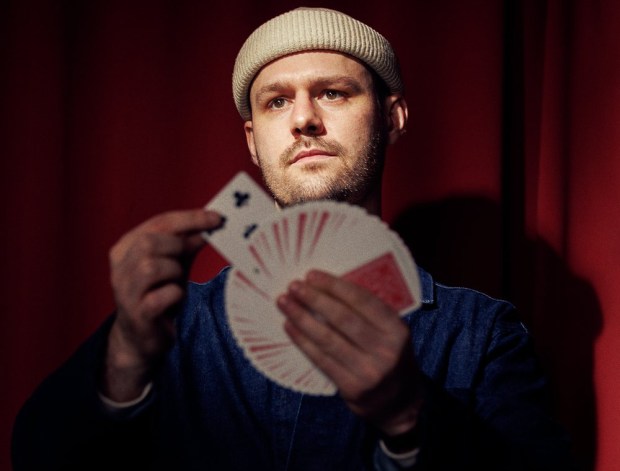
ANDREW FROST: CARDS ON THE TABLE

☆☆☆☆

The show is called Cards on the Table. Upon entering the theatre, the audience sees a mostly empty table with a few books, a lamp, and a deck of playing cards. The first thing that magician Andrew Frost says as he steps on stage is, “I hope you like card tricks”. Anyone who chose to come to this show hoping for anything other than card tricks will be disappointed, and that would be on them.

What follows is, as promised, a full hour of card magic. Frost covers the expected types of tricks in this sub-genre, from fancy shuffling through to trick dealing and card finding. With a whole hour devoted to card magic, Frost is able to delve a little deeper and take common tricks that are recognizable to magic fans that extra step further that more generalist magicians wouldn’t often make time for, especially at a festival like the Fringe with its oft-proscribed time limits.

The unifying feature is Frost’s exceptional skill at card magic and his clear passion for this particular type of magic. If anyone is considering getting in to performing magic (or reviewing it) this is the perfect show to see for an example of what card magic should ideally look like. It’s a classic of magic for a reason, and seeing Frost is a reminder for all who need it of just how impressive card magic can look.  There’s no other theme but the cards and the variety of ways that they can be manipulated, which is all that is needed for Frost’s purposes.

Even at the sold out show that was reviewed, Frost got a decent proportion of the audience onstage for various tasks. Frost is an approachable performer and makes his participants feel welcome. He’s especially helpful in explaining card terminology and even in helping his audience with the most difficult bit of audience participation in a magic trick, remembering which symbol is spades and which is clubs. It’s self serving in that it enables his own show to go more smoothly, but the audience also comes away feeling like they have learned something new and that they can be that tiny bit more comfortable participating in future magic shows.

Cards on the Table is a must see for fans of card magic. Even fans of magic in general who have found card magic underwhelming in the past may gain an appreciation for it in Frost’s hands. Come prepared to be amazed by the entertainment value of the often seen but often under-appreciated type of magic.

More information about Cards on the Table and its performances can be found here.