UK

MAGICAL BONES: BLACK MAGIC

☆☆☆

There is only one hip hop dancing magician at this year’s Edinburgh Fringe, but Magical Bones does not rest on the laurels of the uniqueness of this aspect. Rather, in Black Magic, he has created a show that is both fun and thought provoking, and skillfully performed throughout.

The term ‘Black Magic’ is not in reference to sinister sorcery, or folk magic that the west misappropriated and misconstrued. It is instead for his own position as a black magician. Bones gives honor to  his magician role models by performing tricks inspired by them at several parts of the show, and uses his platform to teach his audience about these underappreciated black magicians of the past.

But Bones is not just good in the shadow of others, he’s pure charm all on his own. Even when a trick or two may falter, the magician doesn’t, and his enchanting personality keeps everyone on board.

Bones not only incorporates his dancing skills into his act, but even a little audience education of it in individual tricks. He shares his personal journey into these combined passions through magical effects as many magicians do, but he has a very unique story to tell. Most compelling of all is a beautiful mix of a classic card effect and a song mash up that accompanies it perfectly.

You don’t have to like hip hop to watch Black Magic, but you may find that you do by the end. Magical Bones has created a fresh and surprisingly educational experience, and he never loses a beat.


More information on Magical Bones and his performance dates can be found here. 

JOHN ACCARDO: METHOD TO THE MAGIC

☆☆☆☆

Magic can be many things, based on everything from the taste of the performer to the perception of the spectator. Magic can be challenging, exciting, classic, smug, one or any or none of the above but something else. But in John Accardo’s Method to the Magic, above all else, magic is joy.

Accardo is a wellspring of effusive, infectious enthusiasm. It is abundantly apparent just how much passion he has for magic, and how much delight he takes in sharing it. This devotion transfers more and more strongly to his audience the longer he spends with them.

Method the the Magic is a very casual show. Accardo chats with his crowd as they come in, banters easily, and makes no attempt to restore order when certain moments of audience participation dissolve into farcical levels of confusion and self consciousness. Rather, he leans into it, letting every moment develop naturally. This cannot and should not be mistaken for lack of control. Accardo is a sharper and more skilful magician than he’s willing to let his audience think he is. The silliness inspires goodwill for him in his spectators, and thus Accardo has won the crowd.

Accardo uses classic magic effects very well integrated into his narrative for the show- explaining what it’s like to be a magician and (almost, sort of) what it’s like to do the tricks. He jumps from mind reading to card tricks and beyond with equal and impressive mastery, and every part is- there’s this word again- a joy – to watch.

This is John Accardo’s first time at the Edinburgh Fringe, but hopefully the first of many. Because it won’t be long before the crowds of Fringe goers discover that in a bunker plopped down in George Square is a hidden gem of the Fringe magic world.

More information on John Accardo can be found here.

MASON KING: SLEIGHT OF MIND

☆☆

Mason King’s Sleight of Mind is a primer on classic mentalism effects. A confident performer,  every piece of King’s show is delivered with the utmost technical perfection, from preparing the audience for what is to come to chaining together the different ways he would read their minds. Nothing in Sleight of Mind is uncomfortable, nothing is offensive. Over the course of the hour reviewed King received one single surprised gasp, a few chuckles, and polite applause for the majority of his tricks, most of them without having to overtly prompt the audience to do so.

But, I’m afraid to say, shows like this are exactly why some people don’t like magic shows. Magic isn’t off-putting when it’s actually bad, no, that makes it horrifically interesting. It’s off-putting when it is bland. Sleight of Mind really is just a primer- nothing more and nothing less than every trick in some fictional volume of mentalism standards, with a few general magic standards thrown in.  Everything from the tricks done to the words around them is like script from someone and everyone else’s book, even when King introduces himself: I was (enter number under 15) years old when I got into magic, here’s a line about my mentor, here’s how I’m going to read your mind.

Sleight of Mind has no narrative, no theme, no gimmick, no twist. King makes no real attempt at comedy and has no sense of comedic timing, nor does he afford the audience a sense of himself, or his personality, or make an effort to tie the humanity and stories of his audience members in. He gives us no reason to care, no reason to be invested, no reason to spend money to see his show. Sleight of Mind is a perfect first draft, a perfect skeleton, a perfect ‘what’ and ‘how’ to overlay with ‘why?’ Now all King needs is to find that missing piece, to find the ‘why’, or, if he knows it, to share it with his audiences. Because truthfully, that it the piece that matters the most.


More information on Mason King and his performance dates can be found here.

LUKE JERMAY: STRANGE POWER

☆☆☆☆

Predicting the future is indeed a strange power. Who even, really, wants to know what comes next? Wouldn’t that take the fun out of it? But for those who have gotten to experience Luke Jermay, the fun of it is undeniable.

Strange Power is not a pretentious show, despite the teeming grandiose of Jermay. It is a thing exactly of itself- a man will come onstage, answer the deepest questions his audience members have of their futures and, sixty minutes later, leave. It is one single act done identically, but it is one single act done incredibly well.

Jermay is an exceptionally powerful performer. From the moment he steps onstage he radiates such a strong sense of presence- despite not saying a word for the first several minutes- that the audience is held in his thrall and wait in their own silent, excited anticipation, so as not to risk missing a word. When he does speak, Jermay is commanding and sharp, but not without genuine warmth. He is the portrait of a man who Knows What He Is Doing, and his onlookers cannot help but be desperate to know too.

Most importantly, Jermay is right, and not just right but exhaustively so. Jermay does not just get a read on each of his chosen audience members, but does so with compelling, intimate depth. Unlike some of his profession, he does not shy away from giving actual advice on the paths that can be taken. He does not fear overstepping- after all, we did ask. His decision to engage so thoroughly allows him to be invested into the futures he predicts, and allows the rest of the audience to be as well. Jermay makes the lives of random strangers who happened to go to the same Fringe show as you as interesting as your own.

Luke Jermay does have a strange power, and few could predict the future as well as he. But one prediction can be made with total confidence by anyone who sees his show: Luke Jermay is only going to build on his already prodigious strengths, and be a household name before long.

More information on Luke Jermay and his performance dates can be found here.

ASHTON CARTER: MYSTERIOSA

In Ashton Carter’s Mysteriosa, he explores the stories of his family history through a series of illusions, both revisiting the mysteries of his ancestors lives and toying with the concept of reaching out to them, through Spiritualist practices, after their deaths.

The beginning of the Fringe can be a stressful time for performers. The material is often untested, the audiences unknown. For a magician, there comes an even more challenging twist to this anxiety: their audience is anxious too. Though you cannot go to a magic show and not expect the looming threat of having to participate, you do not know what form this participation will take. The audience depends on their magician to win- not quite their trust, but their support,  from the beginning moments, or else what’s left is difficult to salvage. Ashton Carter begins, and continues his show, visibly terrified by the situation at hand. His hands shake, his voice shakes, he gets tongue tied, and is seemingly at a loss for what to do from one moment to the next. This creates a sense of unease immediately that does not go away for the rest of the show.

The audience’s wariness of course is also reflected in a disinclination to interact. No one is inspired to want to take part, and those who ultimately do at Carter’s urging do so begrudgingly.  The only common feeling in the crowd is not captivation with the performer, but empathy for one’s fellow onlooker. At the performance reviewed, the show is stolen by a single crack by one audience member.  An entire Fringe show, and the sole highlight is a nervous joke by someone else who is also (maybe) paying to be there.

It perhaps goes without saying at this point, but the material itself is not strong. The illusions are tired, the story is tedious, and the climax cloying and out of place. Finally, there comes a baffling conclusion. Through most of Carter’s show, he has achieved a ineptitude that could and should, for the most part, be pitiable. However, he crowns the whole thing off by concept-dropping Christianity, both in a way where it cannot be argued that that is not what he meant, but where he was too cowardly to actually say ‘Jesus’ in a magic show. Because yes, if you start talking about Jesus in a magic show, 90% of the time unbelievers will be uncomfortable and believers will be offended. And taking into account Carter’s decision to use a deck of cards with an ethnic slur on them earlier in the show, Mysteriosa blows past ‘pitiable’ for a strong finish in ‘dreadful’.

More information on Ashton Carter and his performance dates can be found here.

MANDY MUDEN: IS NOT THE INVISIBLE WOMAN

☆☆

With her bold style and even bolder personality, Mandy Muden is anything but invisible.  Muden’s premise for “Is not the Invisible Woman” is that women “of a certain age” are overlooked often enough to feel invisible, and she has set out to prove that she, at least, still commands attention.

However, Muden is let down by her magic, which is often basic and clumsy.  Her tricks are at their best when she incorporates them into her overall performance, as this marginally raises the audience’s emotional investment.  A section illustrating a romantic relationship ending poorly using several bits of string shifts Muden’s performance to an unexpectedly melancholic tone, despite the maintenance of her playful character, but is a highlight in how she uses magic.

Perhaps ironically, Muden’s many jokes about and references to being a woman “of a certain age” get old fast, especially as they start to sound repetitive.  It is possible that viewers who feel like they fit in to the category that she describes would appreciate this element of her show a bit more, and that she intentionally caters to this audience.  She is at least consistent in maintaining her theme.

Muden develops a patchy relationship with her audience, teasing her participants  slightly more than necessary, even when the participant in question was visibly uncomfortable. She was lucky in that the majority of her participants responded well to this approach.  Her repeated instructions to get her male participants to weigh themselves to contribute numbers for part of her final reveal could be construed as commentary on social pressures on women’s bodies.  However, it is left to the audience to decide whether her method of making this point is too neglectful of the similar pressures on men’s bodies that may be relevant in the lives of her participants.

Muden has a solid goal in her show in demonstrating to the audience and perhaps also to herself that she is not limited by her age and gender.  Her execution may have a more niche appeal.  Nevertheless she certainly succeeds in her aim—in fact, it is difficult to imagine Muden ever being overlooked.


More information on Mandy Muden and her performance dates can be found here.

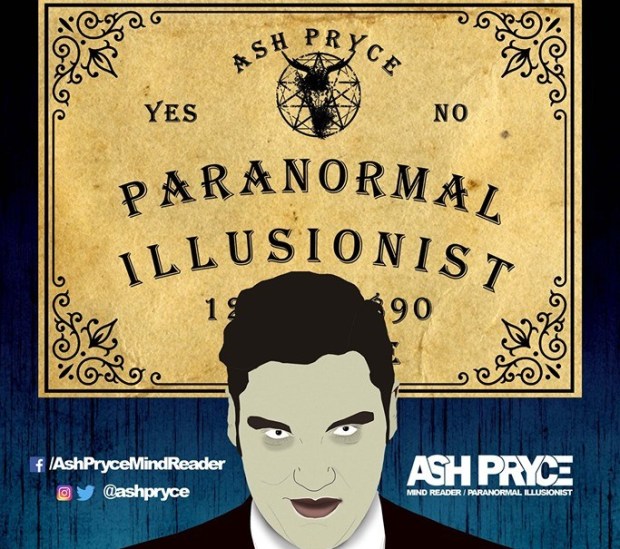
ASH PRYCE: PARANORMAL ILLUSIONIST

One of the most common ways of engaging with Spiritualism in its heyday was an intimate parlor session. Just you, the medium, and a few other select attendees. Ash Pryce’s show Paranormal Illusionist, in this sense, is simply picked up and moved from a parlor to the side room of an only slightly busy bar off an only slightly busy street. But even though the masses of Fringe attendees haven’t found it yet – and fair, it was only day one of performances- Paranormal Illusionist delivers an interesting and well-wrought experience.

Exclusivity isn’t the only thing this show has in common with a genuine Spiritualist experience. Pryce has a lot of knowledge to impart about Spiritualist practices, and all of it accurate, with no unnecessary sensationalism. He is demonstrably aware that Spiritualism is compelling on it’s own, if the audience gets to see it happening in their own hands. The illusions of Pananormal Illusions all involve audience participation, but, a comfort to the wary, all of this participation is lowkey and comfortable to take part in. The audience members enjoy getting to interact with each part as much as they do getting to observe them, and are treated with respect from their illusionist for their trouble.

Participating in the show also makes the audience even more aware of Pryce’s skill as a magician (for of course that is what most successful Spiritualists were, magicians telling you one extra lie). Thanks to the strength of his theme, Pryce was able to do magic tricks that come off as unique and original because they are encased in a overarching story, even if that isn’t completely so. And with these tricks, he performs smoothly, keeping his attendee’s attention exactly where he wants it.

Paranormal Illusionist hasn’t found all of it’s audience yet, but when they find it they will find a clever and well crafted show, as educational as it is enjoyable.


More information on Ash Pryce and his performance dates can be found here. 
 

BILLY REID: WATCH CLOSELY

☆☆

It takes a good magician to entice a busy Edinburgher to Glasgow on a Wednesday evening. Luckily, Billy Reid is worth the trip.  Reid makes his audience for Watch Closely feel welcome as soon as they step through the door, taking the time to learn as many people’s names as possible.  This allows him to address many of his participants by name when inviting them to take part in his show, giving the entire performance a pleasantly intimate and relaxed atmosphere.

The majority of Watch Closely is close-up card tricks, which Reid performs with neatness and style.  Reid lists the awards that he has received for his magic at the beginning of his performance, but he does not really need to, as his evident skill speaks for itself.  Reid’s card tricks set the standard for precisely performed magic, and his storytelling and comedy are executed with the same dexterity, ensuring that the energy of his performance remains constant as he transitions between tricks.  Watch Closely is narratively and thematically cohesive, as Reid uses stories from his life to gradually guide the audience toward the inspiring message with which he ends the show.

If you are a magic fan, you’ve probably seen some of the same tricks repeated often, especially if you see the same magician more than once. But Reid’s tricks are so visually beautiful that watching them again is a joy more similar to that of revisiting a piece of art at a museum.  The use of color in a trick themed on childhood memories of outdoor adventures sets this tone, and it is epitomized in Reid’s incredible illustrated deck that is always a highlight.

Every so often the right performer at the right time is more than entertainment, but also an inspiration to their audience to view the world differently, or the medium to help them process emotions that they might not have even known needed processing.  Reid conveys all of this intensity with his trademark artistry, in what is still unmistakably and unapologetically a magic trick.  The title of his show initially sounds like standard magician bravado, challenging his audience to catch his sleight of hand.  By the end of the evening the double meaning becomes clear, that Reid uses his magical skills to encourage his audience to pay closer attention to their own lives.


More information on Billy Reid and his performance dates can be found here.

THE MIRACLE OF CHRISTMAS FUTURE

☆☆

The Miracle of Christmas Future set out a promising premise, advertised as futuristic magic performed by Charlie Caper, with his amazing robots, and Kevin Quantum, whose performances frequently incorporate his love of science.  They easily deliver on this.  While the show was not flawless, it had many magical and scientific highlights.

The most overtly futuristic element of the show is Quantum and Caper’s third performance partner, the artificial intelligence named Bob.  Bob primarily functioned as an emcee for the human magicians, occasionally also rating their performances, and even taking her turn at performing a magic trick.  While she was not convincing enough to make any reviewer or magician fear that they might soon be replaced by robots, her recurring participation in the show alluded to these exciting potentials for the future of AI.

This left the majority of the magic performed in Quantum and Caper’s able hands.  An unexpectedly lovely highlight was Caper reading a sad Christmas story while performing complementary magic.  This was an odd tonal choice, as it briefly brought the otherwise cheerful Christmas mood down several notches.  The apparently random tone shift only highlighted the disjointed nature of the show as a whole, as aside from Bob’s work as a show runner there was little binding the elements performed together.  This particular moment demonstrated that even that futuristic theme occasionally wavered.  However, the beauty of Caper’s performance made its inclusion worthwhile.

The disjointed feel of the show did not just come from the lack of consistent use of theme, but also from the way that Caper and Quantum rarely actually performed together, instead taking turns with their tricks.  This was a shame, as while no pairing could match the perfect connection between Caper and his robots, Quantum and Caper appeared to work well together when they did interact on stage.

Audience participation often seems to be one of the more challenging aspects of magic performance from the perspective of the watching members of the audience, as the wrong randomly chosen individual might not act according to the magician’s plan.  This looked to be the case in Quantum and Caper’s final performance of this run when two children got a little too competitive with their onstage task.  Quantum and Caper dealt this turn of events with professional aplomb.  Quantum was especially impressive in his handling of the unrulier child.

The futuristic theme of The Miracle of Christmas Future comes naturally to both Caper and Quantum.  It could perhaps even be the theme of each one of their individual magical careers.  Watching them collaborate in sharing that passion with the audience was the most magical part of the evening.


More information on MagicFest can be found here

MICHAEL RAJASINGAM: AN AWKWARD MAGICIAN WITH A LEMON

☆☆

As he admits in the title of his show, Michael Rajasingam is awkward in An Awkward Magician with a Lemon.  Luckily for the audience, it is a relatable, humorous type of awkwardness that adds charm to Rajasingam’s performance.  Rajasignam spends plenty of time in his show allowing this humor to take center stage.  His magic tricks are entertaining as well, although perhaps not so consistently, and he does occasionally have trouble combining the comic and magic aspects of his performance.

There are several points in the show in which Rajasingam successfully combines his magic tricks with his performance.  The recurring motif of the lemon is a fun acknowledgement of the title of his show.  In an unrelated moment, Rajasingam takes the time to tell a sweet story about his family as he performs a coin trick.  This unexpectedly heartwarming routine is a break from the overall awkward humor that nevertheless harmonizes well with the rest of the show.

Unfortunately, Rajasingam’s performance of his other tricks is not always so impressive.  There are a few times that he is noticeably distracted from the thread of his show to focus on getting a trick right.  At other times, his sleight of hand is lacking, and his props might be visible at the wrong times.  Both of these flaws simply require more practice to perfect his skills and integrate them with his performance.

The awkwardness of Rajasingam’s performance allows his relationship with his audience participants to develop a little bit more easily, as it is difficult to feel conspicuously awkward when standing on stage beside Rajasingam.  Audience participants quickly feel at ease.  Rajasingam is kind to those who he invites to join him, using them to demonstrate his tricks while still ensuring that they get to see the full extent of the magic.

While Rajasingam’s performance is not perfect, he is dependably entertaining and fun to watch.  He uses his awkwardness as a character quirk rather than allowing it to hinder his performance.  Rajasingam’s mistakes are only momentary, the overall effect of his show is delightful.


More information on Michael Rajasingam and his performance dates can be found here