
Month: August 2018

CHRIS COOK: CONCEALED

Chris Cook is quite probably the hardest working magician at the Edinburgh Fringe. A consummate professional who holds his audience in his thrall during his stage show, in Concealed, Cook also proves that he has the personability necessary for a fantastic close-up performance.

Concealed’s venue is a tiny room in the basement of the Street bar. The scent of weed wafts gently down from above, and the decor includes disco balls, a cherub, ducks, and twee wallpaper. And in the middle of all this, Cook practically vibrates as he bounces endearingly from taking music requests, gulping down an espresso martini, and bantering with his audience with charming earnestness as he tries to fit everyone into the room.  The place is tiny but the show well attended- knowledge of Cook’s skill has spread by word of mouth and everyone is eager to see for themselves.

Cook performs the traditional, but he performs the traditional well. Even if you’re familiar with magic and you’ve seen the tricks he does before- and surely you have, as he does a rendition of the oldest trick in the world- nothing ever feels even remotely stale. He breathes exuberant almost to the point of manic energy into this intimate performance. Close up magic is a really fast way to separate the truly talented magicians from the deceptively clever showmen and Cook is, actually, both. Every trick is precise, and if it weren’t, we would never have been given the opportunity to realize. Every joke hits, and if it hadn’t, it would have been transformed into one that did. Cook is as quick on his feet as he is with his hands, and even though watching him work makes one exhausted for him, it’s also oddly exhilarating.

Concealed is a performance intentionally under-advertised, because at heart it’s just a guy, keen about magic, sharing it with a small and cheerful crowd. There’s no overarching theme, there’s no moral to no story, it’s a sparse show content in in its own purity, and a purely good show.


Chris Cook can be found at The Street (Venue 239) during the 2018 Edinburgh Fringe at 19:45 from August 15-25. 

More information on Chris Cook and his performance dates can be found here
MICHAEL BRANDIE: BIZARRE

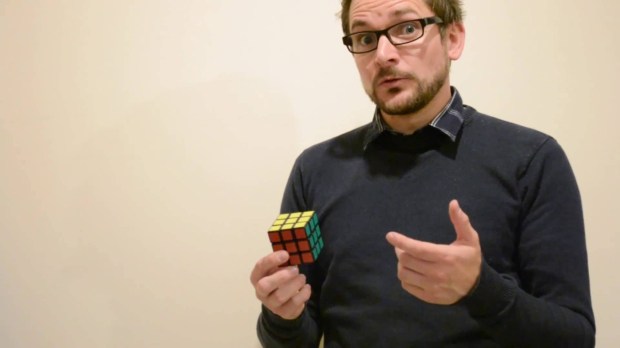
Michael Brandie opens Bizarre by saying that he was shunned from the mind reading community for doing magic, and from the magic community for doing mind reading. This might sound a little bit odd to anyone who has just spent a week at the Fringe watching magic shows, as many incorporate elements of both mind reading and sleight of hand, which may be what Brandie is referring to when he says “magic”. However, while he does do some mind reading, Brandie’s focus is primarily the types of magic tricks that might be classed as dangerous stunts, or perhaps “scary magic”.

A theme of Bizarre is Brandie’s love for old films, he uses film names in mind reading tricks and references films in the set-up for many of his stunts. This does not put off viewers who are unfamiliar with his favorite films, as he explains all of his references thoroughly enough for his audience to understand them. However, it adds an extra level of engagement for film fans in the audience, and even for those who are not in the know it is lovely to see that added personal element give flavor to the show.

Brandie’s stunts are varied, covering a range designed to inspire disgust and alarm in the audience. Some start nice and peaceful before Brandie begins the scare tactics, while others are unapologetically frightening from the start. These are fantastic from a performance perspective. Brandie is reassuring enough at the start of each trick that the audience becomes reasonably certain that he is in no life threatening danger, only to perform stunts dangerous enough that they doubt their former certainty.

Live theater can be unpredictable, especially live theater that requires audience participation, and Brandie encountered such an unpredictability this evening when one of his participants was unwilling to come up on stage. Brandie dealt with this well, performing the effect in a way that allowed this participant to remain in her seat. Such respect for his audience’s boundaries was especially reassuring in this danger-driven show.

Brandie is great at what he does in Bizarre, and this type of scary magic surely has its niche in the magical community. For those that enjoy the bizarre, even at its most disgusting or frightening, Brandie’s Bizarre is the place to be.


More information on Michael Brandie and his performance dates can be found here
THE GRUMPY MAGICIANS: NEVER GIVE A SUCKER AN EVEN BREAK

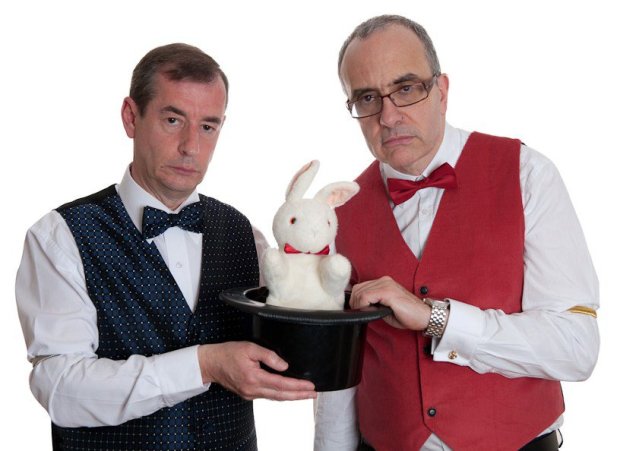
Two charming gentlemen, Paul Novak and Johnny B Good, perform a delightful show as The Grumpy Magicians for the first week of the Fringe. In Never Give a Sucker an Even Break, The Grumpy Magicians are upfront about their goal, to con their audience, who, they determine early on, are all suckers. They do, at the very least, successfully steal a place in their audience members’ hearts.

The Grumpy Magicians rely on classic magic tricks to fool the audience. They even produce a rabbit in a hat—luckily a toy rabbit, to avoid any implications of animal abuse. A highlight includes a blender, a less common prop at magic shows. Some of their tricks do lack deftness, and there are moments when the audience sees a prop before they should, or the face of a card a little bit too early. However, the majority of the tricks are done with suitable skill to conceal the deception.

To be fair, any inconsistencies in The Grumpy Magicians’ magic hardly matters, as their appeal is in their charm and rapport, both with each other and with their audience. Despite the grumpiness, they have a solid partnership. They work smoothly together and appear dependably supportive of each other. This is especially nice to see in a magic show, as magicians often perform solo and can look very lonely up on stage by themselves.

Audience participants likewise feel safe in the hands of The Grumpy Magicians. The Magicians take advantage of their age to take a grandfatherly attitude toward their participants, which they manage to do without straying into being too patronizing.

While The Grumpy Magicians might not be the most expert magicians at the Fringe, their act is lovely. They adapt well to performing appropriately for any children in the audience, making them a great family option. The Grumpy Magicians make for a solidly entertaining hour as both magicians and entertainers in general.


More information on The Grumpy Magicians and their performance dates can be found here

KEVIN QUANTUM: VANISHING POINT

Kevin Quantum studied physics before he became a magician, and in Vanishing Point he explores the magical niche that he has created by combining his passion for both subjects. The stage is physically dominated by an enormous harmonic pendulum of his own creation that both starts and ends the show. Watching this pendulum in motion at the start of the show is a lovely meditative highlight. In between showing off his pendulum, Quantum performs his array of magic tricks with the theme of making things vanish.

One of Quantum’s primary sub-themes is the Bermuda triangle, famous for making ships, planes, and people mysteriously disappear. Quantum spends a fair amount of time setting up this theme, telling the audience about some of the better known anecdotes and even playing an audio clip from a plane right before it went missing in the triangle. His method of incorporating the theme into his magic tricks is appropriately cheeky for a magic show.

Loss of privacy and the increasing power of technology over humanity, another one of Quantum’s sub-themes, is much more timely, and potentially much more interesting. This time his cheeky nod to theme in the subsequent magic tricks is more of a build up to the big finish—it may feel underwhelming at first, but by the end of the show it proves fittingly impactful. Quantum circles back to his gigantic gadget, using the meditative qualities of his harmonic pendulum to make his point about the importance of living in the moment.

The foundation of Vanishing Point is in hybrids, as Quantum describes himself as a hybrid scientist-magician, and incorporates both magic tricks and scientific demonstrations into this show. Quantum takes this a step further in blending the tone of the show. It is both fun and lighthearted in turns and a bit more serious in others, but does not fully commit to either approach. The lighthearted bits at the beginning still have the dark undertones of death from the Bermuda triangle theme, and the delivery of the sincere message at the end still feels more like a stunt than a moral. This is not detrimental to the overall effect of the show, and feels on brand for Quantum, who has built his magical persona on hybridization.

Vanishing Point is creatively themed and well put together, and well performed in Quantum’s distinctive style. The creative emphasis is decidedly on the theme and non-magical props rather than the tricks themselves, but given the multi-faceted nature of the show this is not too noticeable. Vanishing Point is well worth a visit for those looking for see magic tricks presented in an inventively scientific format.


Kevin Quantum can be found at Underbelly Bristo Square during the 2018 Edinburgh Fringe at 18:45 from August 12-20, 22-26

More information on Kevin Quantum and his performance dates can be found here

ADAM PATEL: BROWN MAGIC

Adam Patel has chosen the classic theme of his own life story, for his show Brown Magic, and the development of his interest in magic. Patel uses his magic tricks to complement and illustrate the stories that he tells. His anecdotes and jokes do often use stereotypes, but he does not rely on stereotypes to get cheap laughs, rather he uses them in his own original manner. Patel’s magic tricks are likewise well performed and effectively used.

Brown Magic began with Patel offstage, directing audience participants through a first trick using his voice alone. This did run into a slight speed-bump, through no fault of Patel’s own, as the participant chosen to read the denouement of this trick had to run back to her seat to get her reading glasses, but Patel dealt with this well, making sure that the audience was entertained and his participant felt comfortable. Patel’s expert handling of the situation turned a potential blunder into charming introduction, ensuring that by the time he physically stepped on stage the audience was already on his side.

Patel’s main sleight of hand trick is performed alongside his story of trying to impress a childhood crush with magic. This story certainly increases the audience’s sympathy for Patel. His well executed trick brings the mood back up, as he demonstrates both his recovery from childhood disappointment and his increased magical skills as an adult.

Patel’s take on mind reading is interesting and modern, as he bases one of his mind reading demonstrations on Tinder, and, for another, uses an app of his own design. The latter is used especially creatively, although it is definitely for the best that Patel specifies at the start of this segment that he wants an audience participant who doesn’t take himself too seriously. Patel’s final trick is similarly creative, imbuing magical tropes with his own unique flavor.

Brown Magic is solidly entertaining. Patel uses his life story to create his particular take on magic very effectively. While many of his magic tricks are fairly standard, Patel performs them well, and uses them in an interesting manner over the course of the stories that he tells.


Adam Patel can be found at Sweet Grassmarket (Venue 18) during the 2018 Edinburgh Fringe at 18:40 until through August 12th. 

More information on Adam Patel and his performance dates can be found here

COLIN CLOUD: PSYCHO(LOGICAL)

Colin Cloud begins Psycho(logical) by saying that as, in this show, he will be discussing us, the audience, it is really our own fault if we do not like it.  This sets the tone perfectly—Cloud maintains that ominous and facetious balance steadily for the duration of the show.  Cloud consistently astounds his audience with his mind reading tricks, and uses both classical and unusual techniques for scary magic to great effect.

The first half of Psycho(logical) is more expected magical fare.  The audience files in to find Cloud already on stage, taking notes, but his condition quickly evolves into an escape artist themed situation.  Cloud’s calm demeanor throughout his change in situation could be interpreted two ways, either that he is confident in his control over his show, or that his tranquility when facing apparent death does indicate that he is, as the title of is show suggests, a psychopath.

Midway through the show Cloud switches gears, framing the majority of his second half as a séance-style attempt to communicate with the dead.  This is, he explains, a bit of a tribute to the creator of his beloved Sherlock Holmes, Arthur Conan Doyle, who was a prominent spiritualist.   This spiritualist theme allows Cloud to incorporate mind reading, hypnotist, and even meditative techniques to create his effects.  The emphasis is always on the mind reading, Cloud’s specialty, but the addition of the more varied techniques accentuates the story line of that segment, to Cloud’s benefit.

Notably, given the nature of Cloud’s show, he is nevertheless kind to his audience participants.  Cloud reserves the majority of his sinister affectations for the audience as a group, and is much more considerate when interacting with the individuals who put themselves before their peers to help him perform his tricks.

The split format of Psycho(logical) works well for Cloud.  While his séance themed section is certainly engaging, the premise may have felt a bit thinly stretched if he had attempted to hold it for the entire hour.  The only issue is that he did spend such a significant portion of his show on a segment that seemed to have little to no relation to his Psycho(logical) theme.  Cloud did end with a throwback to the start of the show that successfully tied the evening together, but these were external to the séance section.

Psycho(logical) is dependably impressive and reliably entertaining throughout.  Cloud’s séance section was a delightfully creative framework both to showcase his mind reading tricks and allow him to explore related techniques, but did feel like its own self-contained mini-show dropped randomly into the otherwise Psycho(logical) themed main event.

At the start of the show, Cloud claims that any member of the audience may be unknowingly sitting beside a psychopath.  By the end, the one thing that is clear is that, regardless of Cloud’s true mental state as a man, as a magician he certainly plays an entertaining psychopath.


Colin Cloud can be found at Pleasance Courtyard during the 2018 Edinburgh Fringe at 20:00 from August 9-13, 15-27 

More information on Colin Cloud and his performance dates can be found here
KEVIN QUANTUM: AND FOR MY NEXT TRICK


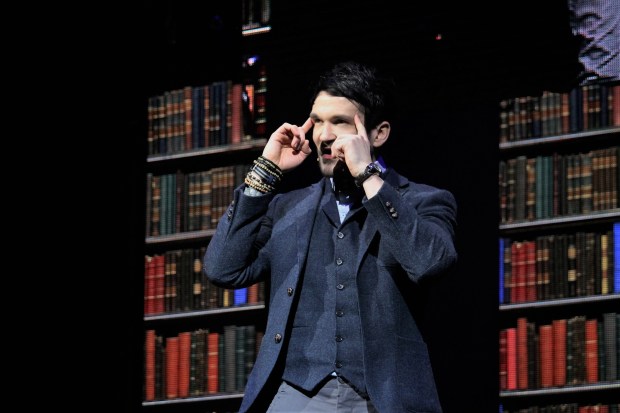
In And For My Next Trick, Kevin Quantum fully embraces the silly side of magic.  The slightest notion of a theme gives the show some structure, while allowing Quantum to perform a wide range of varying tricks.  Quantum takes advantage of this freedom to show off an impressive breadth of versatility for an hour long show.

Early in the show, Quantum performs a well-judged card trick.  Quantum’s audience is just big enough that the people at the back might have had trouble seeing a playing card, but Quantum made sure to use a heavily marked card for the duration of the trick to avoid any such difficulties.  Quantum performs this trick with dexterity and poise, demonstrating his skill in classic sleight of hand.

Quantum gets into more story-based magic as well, with a magical attraction themed segment featuring a mock date with an audience participant.  In such a trick the choice of participant is key, as they have a slightly more involved role than just picking a card, and Quantum chose perfectly.  His participant appeared delighted to have her turn on stage, which made that part of the show even more delightful to watch.  The theme led Quantum into a performance that was at times more comedy-based than magic, but this was no disadvantage as he entertained the audience throughout.

Performing can be unpredictable, and Quantum is adept at handling potentially challenging variables.  Quantum has a good rapport with his audience.  If he teases the participants who he brings on stage he comes across as friendly rather than antagonistic.  Additional disturbances arose on this evening with equipment difficulties and an unusually noisy fan, but Quantum dismissed these with a smile and a joke, and did not allow them to have any detrimental effect on his performance.

Quantum uses And For My Next Trick to bring the audience on a quick journey through the more playful parts of his repertoire.  Quantum seems to be having as much fun on stage as the audience is having watching him, which makes him all the more enjoyable to watch.


Kevin Quantum can be found at Gilded Balloon Teviot during the 2018 Edinburgh Fringe at 21:30 from August 9-20, 22-26

More information on Kevin Quantum and his performance dates can be found here

PETE FIRMAN: MARVELS

Pete Firman describes himself as a “comedy magician”, and it is his balance of comedy and magic that set Marvels apart.  Firman’s comedy does not feel like filler in between magic tricks, but like an equally valuable and sizable component of his show.

One highlight epitomizes this balance.  Firman uses a gigantic deck of cards for this section of the show, which he shuffles and then has an audience volunteer cut at random.  However, rather than then proceeding with a magic trick as the audience might reasonably expect, Firman tells a fantastically pun filled story based on the order of the cards in the deck.  This balance proves to be characteristic of Firman’s performance.

In a more magical sequence, Firman gets a couple of audience participants to join him on stage while he borrows a ring from one of them to use in his tricks.  While he could be a bit kinder to his audience participants, luckily the individuals who he had onstage seemed unfazed.  Firman performs his ring tricks with skillful precision, and an impressive degree of personal flair.

Firman unapologetically takes another break from magic when he uses a physics demonstration to mix drinks.  The principle is simple enough, and Firman’s attempts to build tension may seem especially overly dramatic to audience members who had enthusiastic physics teachers.   It is all the more impressive that Firman is able to seamlessly integrate such an experiment into his show, in a manner that does not feel out of place or any less entertaining to the audience.

Firman delves into classic magic as well, in particular in his utilization of two nesting tubes.  Callbacks to classic magic tricks continue with the materialization of a multitude of scarves.  Firman puts his own twist on the old tropes, and his distinctively idiosyncratic personality ensures that the tricks do not feel too old fashioned.

Marvels could be billed equally accurately as a magic show with bits of comedy, or a comedy show with bits of magic.  Firman is an exceptional performer in either genre, and watching him blend the two is a delight.


Pete Firman can be found at Pleasance Courtyard during the 2018 Edinburgh Fringe at 20:00 from August 6-26

More information on Pete Firman and his performance dates can be found here
SEAN HARRINGTON: SELF DECEPTION

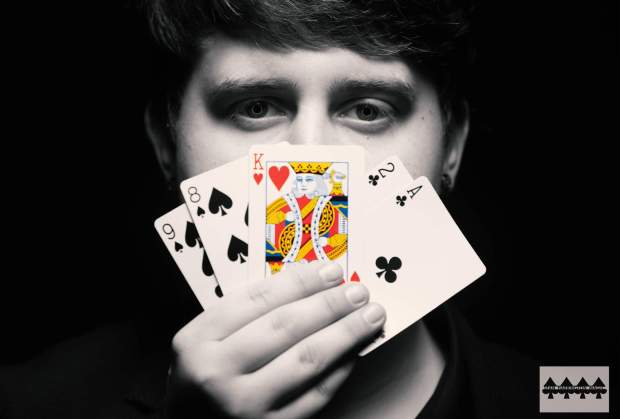
Perceptual manipulation is an inherent component of magic, but is rarely discussed in any depth in magic shows.  Sean Harrington’s Self Deception is a well assembled show that highlights several of the facets of psychology that are especially relevant to magic.  This does not come across as a psychology lecture, for better or for worse, as the emphasis is decidedly on the magic tricks.  Nevertheless, the psychological themes prove effective at creating a structure for Harrington’s magic.

In one of his opening sequences, Harrington uses coin tricks to illustrate inattentional blindness, perhaps more famously illustrated in the experiment involving basketball players and a gorilla that Harrington cites as inspiration.  These are well performed, and easily engage the attention of even the children in the audience.

Harrington frames another trick as a tribute to the discredited science of phrenology.  While the way in which he “uses” phrenology is not really how phrenology works, this is perhaps forgivable as phrenology does not actually work, a fact with Harrington makes sure to state to his audience.  It does, however, work as a fun framework in which Harrington performs his tricks.

There is room for improvement in Harrington’s performance.  His magic tricks are skillfully done, but he might work on his use of the time between tricks, which does occasionally fall a bit flat.  This is especially noticeable in his final trick, which requires some length of preparatory work prior to the big reveal.  Harrington gets the audience involved in this stage, but it does still feel like the dull necessary procedure to reach the exciting conclusion, rather than an integrated and entertaining component of the show.  Performing well through these transition times is key to creating a cohesive show out of a collection of tricks.

In Self Deception Harrington has put together a fun set of magic tricks, which do for the most part fit in well with his psychology theme.  Harrington interacts well with an audience of mixed ages.  While there are elements of Harrington’s performance that could definitely do with more polish, his creative use of his theme has enabled him to design an interesting magic show.


Sean Harrington can be found at La Vida Room 1 (Venue 113) during the 2018 Edinburgh Fringe at 19:30

More information on Sean Harrington and his performance dates can be found here

AARON CALVERT: DECLASSIFIED

Aaron Calvert has chosen a timely theme for his new Fringe show, Declassified. As Calvert explains in his opening remarks, on his inauguration, Trump declassified vast archives of information about some of the United States’s quirkier Cold War era research projects. Calvert’s jokes at Trump’s expense ensure that his audience knows that he is on the right side of history. The rest of the show is framed as an exploration into these declassified archives.

An early segment of Declassified features a classic mind reading trick using several cards with a range of simple shapes. This fits neatly into the Cold War theme. The story often told alongside these props is that they were used by the CIA to study subjects’ mind reading capabilities during the Cold War, and that when the Cold War ended and these research projects were disbanded several subjects used the same cards to demonstrate their skills in magic shows. Calvert puts his own stamp on this classic by adding a hypnotist twist.

Calvert soon shifts into the more hypnotism-centric part of the show, attempting to put the entire audience into a hypnotic state in order to find the best participants for the evening. The process is pleasantly relaxing, even for those who do not reach a full hypnotic trance. A selected few of those who do make it to that state are brought onstage to demonstrate the depth of their hypnosis. Unlike the seedy hypnotist stereotype, Calvert is respectful and empathetic toward those who he has successfully hypnotized.

Here Calvert shifts from his stated theme of the recently declassified files that he discusses at the start of his show, and spends more time relating his demonstrations to modern urban legends. Cold War enthusiasts may be disappointed. However, Calvert’s interpretation of this theme is ultimately uplifting. Rather than re-create the experiments of the Cold War era, Declassified is a new experiment designed to demonstrate the same theory, that individuals are capable of extraordinary feats.

If there is a criticism to be leveled at Declassified it is precisely that, its title. The titular declassified documents feel underused, as they are hardly mentioned beyond the opening political quips. The link between the Cold War theme and the later segments of the show is muddled with Calvert’s increasing reliance on modern urban legends to bring thematic structure to his demonstrations. Declassified would perhaps be better described by a title that evokes urban legends in general rather than one evocative of such a specific aspect of history.

Declassified succeeds as an impressive display of hypnosis, and is enhanced by Calvert’s optimistic attitude toward his audience. Calvert’s style of hypnotism comes across as benevolent rather than manipulative, as he proves his power over his hypnotized participants by compelling them to perform exceptional stunts rather than pointlessly embarrassing actions, while still putting on an entertaining show for his audience. Calvert’s refreshing take on hypnosis makes Declassified well worth the visit.


Aaron Calvert can be found at The Gilded Balloon at the Museum during the 2018 Edinburgh Fringe, at 18:00 on August 5-26

More information on Aaron Calvert and his performance dates can be found here